
Cornish Dragon Folklore
Updated: 2 days ago
Cornwall has surprisingly few dragons, and some of the ones we think we have may not have any talons in the soil at all.
In this blog, I want to look at an Orcadian sea monster that somehow ended up in St Just, a dragon story that may have been created by a tourism venue, a saint who leads a serpent into the sea rather than killing it, a possible dragon hiding inside Padstow’s ‘Obby ‘Oss, and the later idea that dragon energy runs beneath Cornwall itself. We will also get into Helston’s May traditions, the Reformation, a spectral hound fighting a dragon above the north coast, and an April Fool’s dinosaur that still occasionally gets repeated as genuine Cornish palaeontology.
The more I researched Cornish dragon folklore, the less compelled I became in producing an extensive list of scaly beasts and the more interested I became in finding out how these stories got here, because some have travelled leagues, others have been woven together from completely separate traditions, and a few may have been invented really quite recently.
One source I kept coming back to was Andy Norfolk’s Cornish Dragon Lore, published in Meyn Mamvro in 1997, which gathered together a number of these scattered traditions and gave later writers somewhere to start. Once you begin tracing individual stories backwards, though, the picture quickly becomes much more murky.
So rather than asking simply which dragons belong to Cornwall, I think the better question is how these creatures arrived here in the first place, and why a county overflowing with giants, mermaids, piskies, saints and spirits of the mines seems to have so few dragons of its own.
Where are all the dragons?
Cornwall is hardly short of monsters, yet the dragon, which appears almost everywhere else in British folklore, never became quite as dominant here. We have giants tossing stones across the landscape, mermaids arising from the deep, piskies leading people astray, knockers inhabiting the underworld and saints claiming wells, chapels and wild places, so there may simply have been less room for the dragon to carry out the same tasks.
One possible influence is Scandinavia, because northern Britain weathered centuries of Norse settlement, language and storytelling, while the Norse world itself is filled with great serpents and dragons. The most famous is Jörmungandr, the Midgard Serpent, which grows so large that it encircles the world and eventually faces Thor at Ragnarök. Cornwall certainly experienced Viking raids and contact, but it did not see Scandinavian settlement on anything like the scale found in Orkney, northern Scotland or parts of eastern England, and it is possible that this helped shape the difference in the creatures that became established here.
I would not take that too far, because dragons already had plenty of other routes into Britain through Christian scripture, classical mythology, Welsh tradition and the lives of saints. No single culture brought the dragon here, and there was never one fixed idea of what a dragon actually was.
That becomes especially important when we encounter the word “worm”, because the older use of worm or wyrm could mean a great serpent or crawling monster rather than the harmless little thing turning over your compost. Many British dragons seem to have started life as serpents, with legs, wings and fire sometimes added much later.
The Mester Stoor Worm that came from Orkney
If you search online, the Mester Stoor Worm is sometimes presented, up-front, as one of Cornwall’s great dragon legends. It is usually attached to St Just in Penwith, where modern versions describe a huge serpent destroying crops, killing animals and terrifying the population until a man named Mathey Trewella steps forward from the brink and defeats it.
The tricky thing is that almost every important part of that story belongs somewhere else.
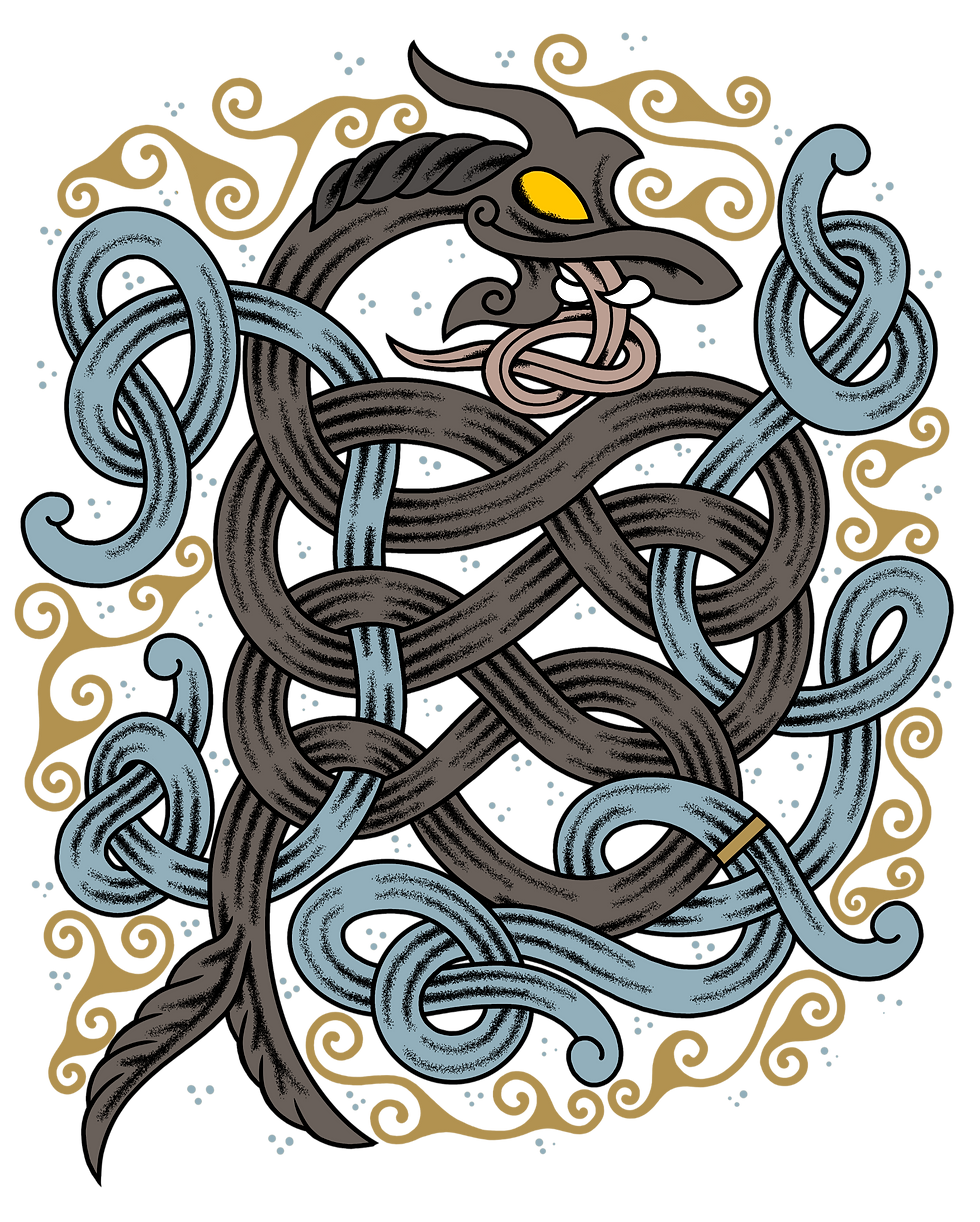
The Mester Stoor Worm belongs much more securely to the folklore of Orkney, where the story was recorded in the nineteenth century by Walter Traill Dennison, an Orcadian antiquarian who had heard versions of it from local storytellers when he was young. In that tradition, the Stoor Worm is not simply a large snake hanging around a village but one of the greatest sea monsters imaginable, with breath so foul that it poisons plants, animals and people.
The story tells of a kingdom forced to provide the monster with seven young women every week until the king finally offers his own daughter, his kingdom and a magical sword to whoever can destroy it. The hero is not a warrior or noble knight but Assipattle, the youngest son of a farmer, who allows himself to be swallowed and destroys the creature from within.
Its death then changes the geography of the world, with its teeth becoming Orkney, Shetland and the Faroe Islands while its body becomes Iceland. This is much closer to a creation story than a village tale about a troublesome dragon, and it has obvious echoes of the enormous serpents found throughout Norse mythology.
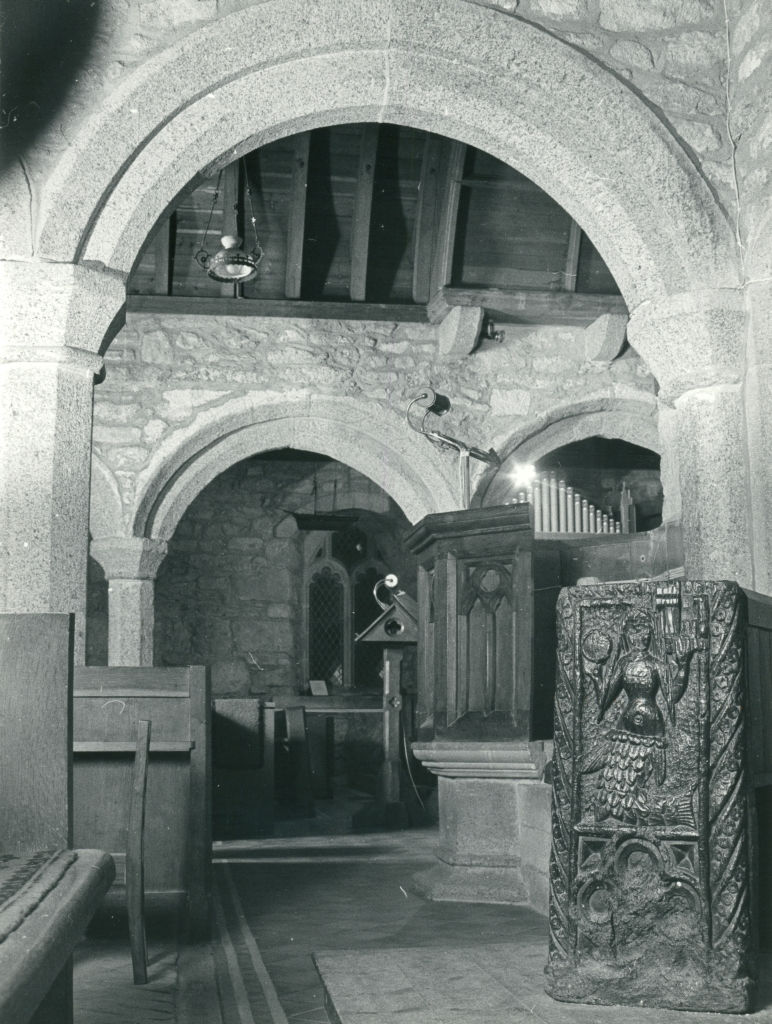
The Cornish version becomes stranger when we look at the name of its supposed hero, because Mathey Trewella is far more closely associated with the Mermaid of Zennor. In William Bottrell’s nineteenth-century telling, Mathey is the young singer who disappears beneath the sea with the mermaid.
So we appear to have an Orcadian sea serpent moved hundreds of miles south and then given the name of a character from an entirely separate Cornish legend.
That makes the Stoor Worm less useful as evidence for an ancient Cornish dragon and far more useful as evidence for how easily a convincing local myth can be assembled from existing parts.
A dragon legend caught in the act of creation

The Dragon of Looe fascinated me because on one hand, we may be looking at a legend very close to the beginning of its life; on the other, it is potentially an AI-generated tale created to enthral tourists.
The story circulating online tells us that a huge dragon lived in the hills near the town, with scales as hard as armour, glowing eyes and breath capable of setting the countryside alight. It attacks livestock, destroys crops and threatens trade until the people call for a hero, although several knights are apparently killed before an unnamed warrior finally arrives after receiving guidance from a saint or mysterious figure.
This knight is given an enchanted sword and shield, survives the dragon’s fire and eventually kills the beast with a blow to the heart, after which the townspeople discover a cavern full of treasure supposedly taken from ships and surrounding settlements. The riches are then used to rebuild the town, while a monument is erected to commemorate the victory, fragments of which are said to survive somewhere in the area.
It is a riveting dragon story, but I cannot find a convincing older source for it.
The version I have reviewed comes from modern tourism material, and one circulating copy even contains fragments of escaped HTML such as broken paragraph and emphasis tags sitting inside the prose. That strongly suggests we are dealing with text copied from a modern webpage rather than something transcribed from an older oral tale. The generic nature of the tale may even indicate that it was created by generative AI platforms, but we have no proof of that.
The structure also comes across as unusually generic, with a nondescript knight, unnamed saint, magical weapons, treasure, a lost monument and local commemorations that are difficult to verify with any facts. Almost every detail sounds specific until you try to follow it back to something real lurking down the cobblestone streets of Looe. .
My uneducated guess is that the story was created relatively recently by a tourism venue or website because a dragon adds another layer of interest to the area, although I cannot prove the intention behind it.
What interests me more is what has happened since, because the story now exists beyond whichever page or software produced it. It has been repeated, discussed and illustrated, and we have commissioned a brilliant artist to interpret the Dragon of Looe ourselves.
Is this modern folklore caught in the act of creation?
Saints, serpents and dragons in the wrong place
If we want material with much deeper roots, the lives of the early saints give us stronger ground to work with, and one of the best examples belongs to St Petroc.
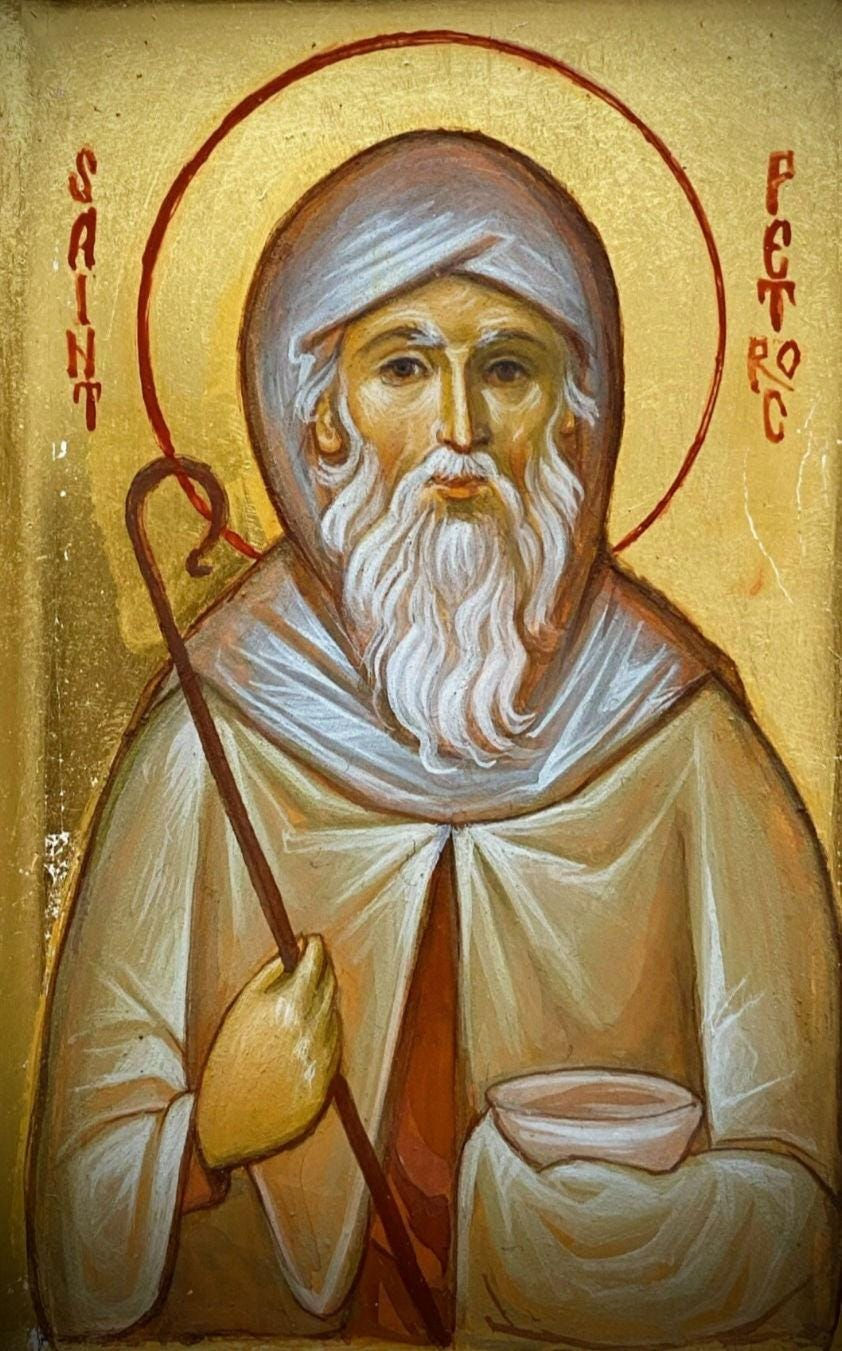
The historical St Petroc probably lived during the sixth century and became closely associated with Padstow, while the surviving medieval Life of St Petroc preserves material written down centuries later. In one story, King Teudar maintains a pit or marsh filled with serpents into which condemned people are thrown, but when the supply of victims ends, the snakes begin eating one another until only a single enormous creature remains.
Petroc does not attack it with a sword or spear. Instead, he places his girdle around the creature, brings it under control and leads it away to the sea before releasing it.
That is a refreshingly different dragon encounter from the version most of us grew up with, because there is no triumphant knight standing over a corpse and no great display of sword-related violence! The saint simply takes control of the monster and walks it to the coast.
Another St Petroc story tells of him helping a dragon with an injury to its eye, again forgoing combat with healing and spiritual authority. These stories belong to a wider Christian tradition in which saints tame dangerous animals or supernatural creatures, but the contrast with Saint George is still striking.
There is another saint worth mentioning because he shows how easily geography can become confused.
St Carantoc is strongly connected with Cornwall through Crantock, and his legend includes a famous encounter with a dragon involving King Arthur, so it is very tempting to add the tale directly to a list of Cornish dragon stories. The medieval account, however, places the dragon episode around Carrum, generally identified as Carhampton in Somerset.
In that story, Arthur is unable to deal with the monster, while Carantoc prays and causes the terrifying serpent to come meekly towards him before leading it away and preventing the people from killing it.
So even one of the apparently obvious Cornish saint-and-dragon stories turns out to take place on the other side of the Tamar.
How Saint George acquired his dragon
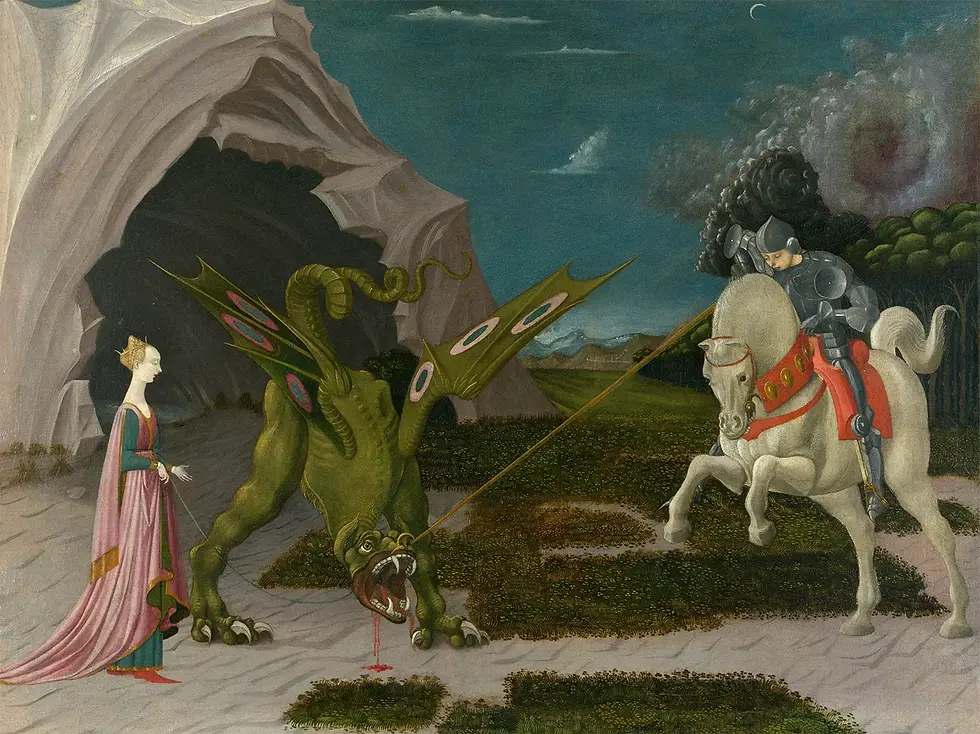
Saint George creates another useful complication because George did not originally have a dragon at all.
He was probably a Christian martyr of the Roman world who died around the beginning of the fourth century, and his cult flourished for centuries before the dragon became central to his story. The familiar western version developed much later, particularly through the enormous popularity of Jacobus de Voragine’s Golden Legend during the thirteenth century.
By then, the usual tropes we recognise are all present: a city under threat, a monster demanding victims, a princess chosen as the next sacrifice and a holy warrior arriving at precisely the right moment to slay the beast.
Even that medieval version is a little different from the image we have in our minds today. George does not simply charge in and immediately kill the dragon; he wounds it, after which the princess uses her girdle to lead the subdued creature towards the city before the story reaches its final violent conclusion.
The meaning of the dragon changed again during the Reformation, when Protestant writers drew heavily on the Great Red Dragon of Revelation and used monstrous, multi-headed beasts as visual and literary weapons against the papacy and the Roman Catholic Church. Catholic writers responded with apocalyptic imagery of their own, and the dragon metamorphosised from saintly mythology into political propaganda.
St George survived this upheaval better than many saints because he had already become part of the English national identity, although the cult surrounding saints was less of a focus.
By 1590, Edmund Spenser could use the same dragon-slayer tradition in The Faerie Queene, where the Redcrosse Knight draws heavily on George but now fights within a specifically Protestant allegory about holiness, error, faith and salvation.
The dragon seems to be the historical equivalent of a successful pop star, successfully changing appearance and style to fit with the latest trend.
Tregeagle and the dragon of punishment
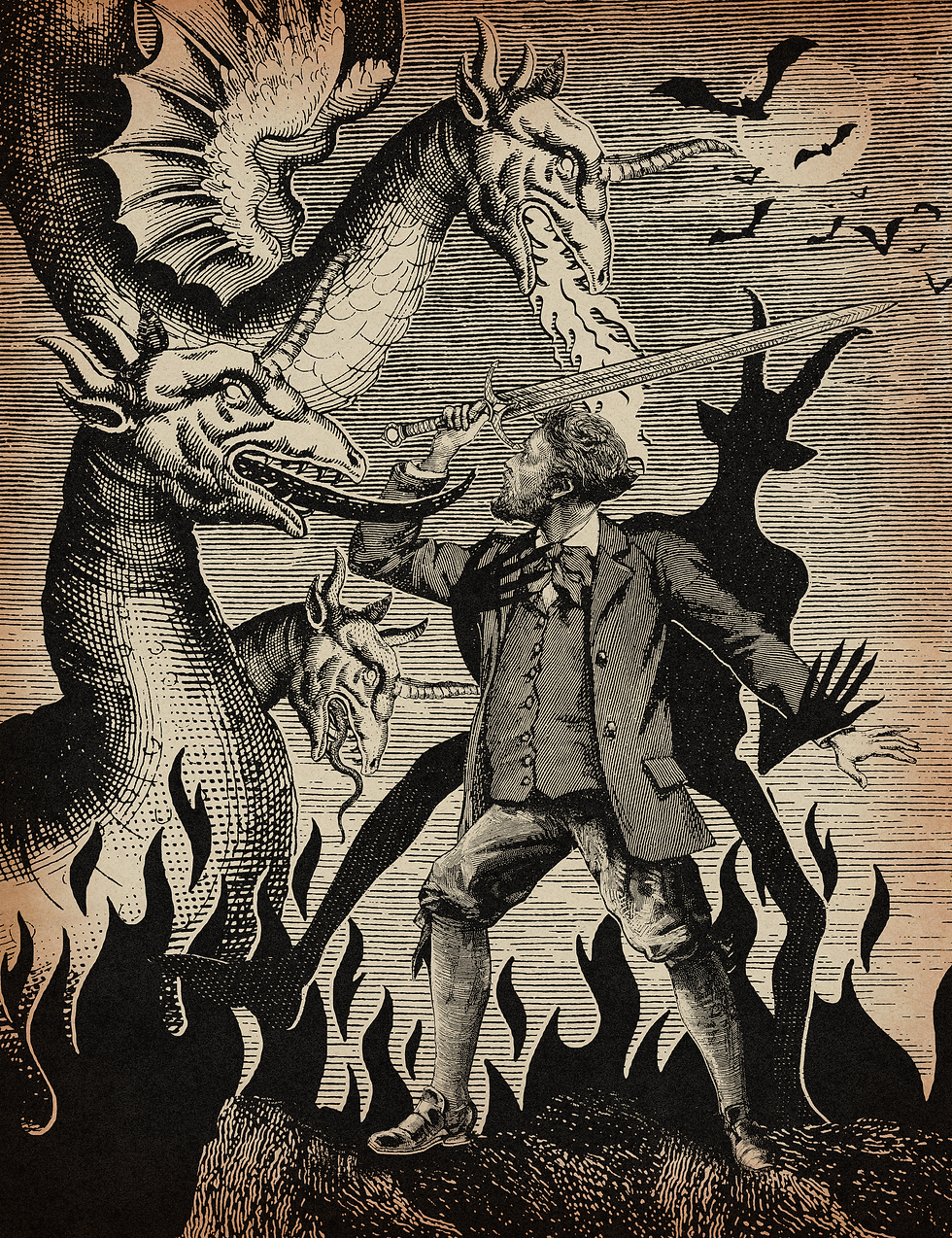
Jan Tregeagle is one of Cornwall’s strongest folk characters, although the dragon sometimes associated with him appears to be on the periphery of that tradition.
The real-life John or Jan Tregeagle was a seventeenth-century Cornish steward and magistrate whose reputation for harshness was transformed after his death into the legend of a condemned soul forced to complete impossible tasks.
He is made to empty pools using hopeless tools, carry sand in containers that cannot hold it and manufacture ropes from sand itself, while his cries are said to carry across the county during storms. The basic idea is wonderfully cruel because every Herculean task is designed to fail.
Some modern accounts add a fiery dragon to his sentence, forcing him into another eternal struggle, and the image fits neatly with the Christian symbolism already surrounding the legend. Dragons were associated with Satan, corruption and punishment, so it is easy to see how one could be added to Tregeagle’s personal hell.
The stronger older versions already contain more than enough torment without it, though, which makes the dragon feel less like the foundation of the legend and more like another punishment added to an already extensive list.
Dragon energy beneath Cornwall
By the twentieth century, the dragon had largely vanished from stories designed to scare others into behaving differently and migrated into popular fiction by world-builders such as C.S. Lewis and J.R.R. Tolkien. However, perhaps they were lying in wait, underground…
One starting point is Alfred Watkins, a Herefordshire businessman and photographer who became convinced in the early 1920s that ancient sites formed long straight alignments across the countryside. He called these routes leys and developed the theory in The Old Straight Track, arguing that prominent hills, standing stones, churches, mounds and other landmarks had once helped people navigate across the landscape.
Watkins’ idea was practical rather than mystical, but later writers transformed it into something much stranger.
John Michell was probably the most influential, particularly after the publication of The View Over Atlantis in 1969. Michell combined ley lines with sacred geometry, ancient wisdom and ideas drawn from Chinese geomancy until the lines became not simply old routes but channels of energy moving through the land.
The dragon returned at that point, although no longer as an animal.
Michell’s best known example was the St Michael line, an alignment that begins around St Michael’s Mount and runs north-east across southern England through or close to sites including the Hurlers, the Cheesewring, Glastonbury Tor, Burrow Mump and Avebury.
Because St Michael is traditionally shown defeating Satan in the form of a dragon or serpent, the alignment came to be imagined as a dragon path, with Michael churches perhaps marking places where an older current had been Christianised or brought under spiritual control.
The archaeological case is hard to persuade sceptics, because Britain contains so many prehistoric monuments, churches, hills and wells that drawing long lines across a map will inevitably produce striking alignments.
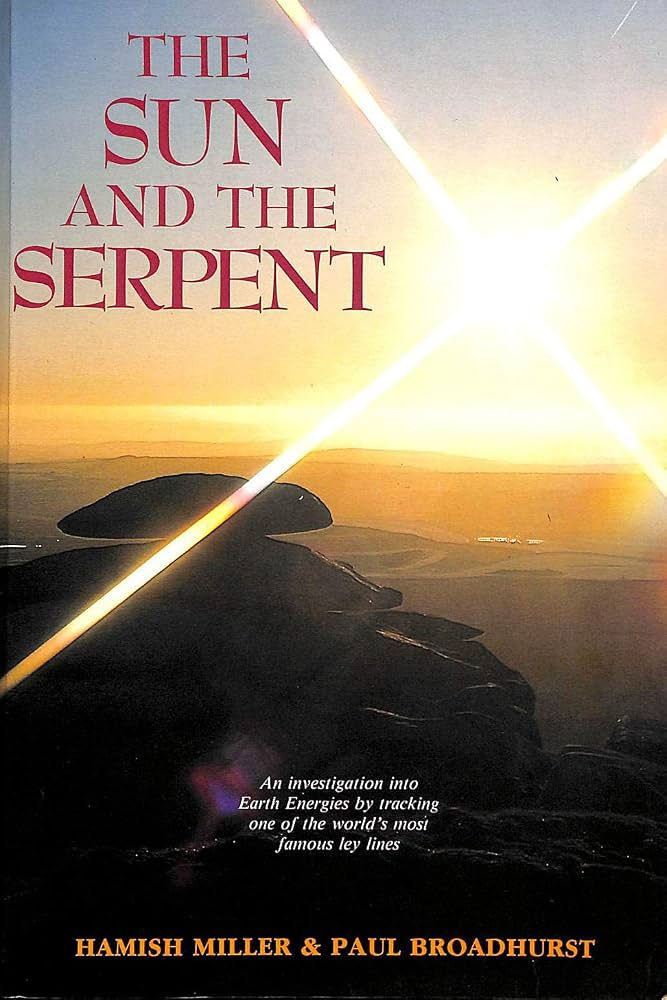
The idea became even more elaborate during the 1980s when Hamish Miller and Paul Broadhurst followed the supposed St Michael alignment using dowsing rods. They described two separate currents winding around the broader line, naming one Michael and the other Mary, with the pair twisting through the landscape like serpents.
I do not need to believe that these are measurable currents of energy to understand why the idea remains appealing. It turns places such as St Michael’s Mount, the Hurlers, the Cheesewring, Carn Brea and the old churches into points within a much larger, perhaps pre-ordained, pattern by our Neolithic ancestors who constructed some of these marvels.
The May Day dragons
Some Cornish dragons are way easier to find because we still bring them out into the streets each year.
Helston gives us the clearest example through Flora Day and the Hal-an-Tow, where older dramatic characters, song/dance, local history and seasonal celebration come together in one wonderfully unruly performance.
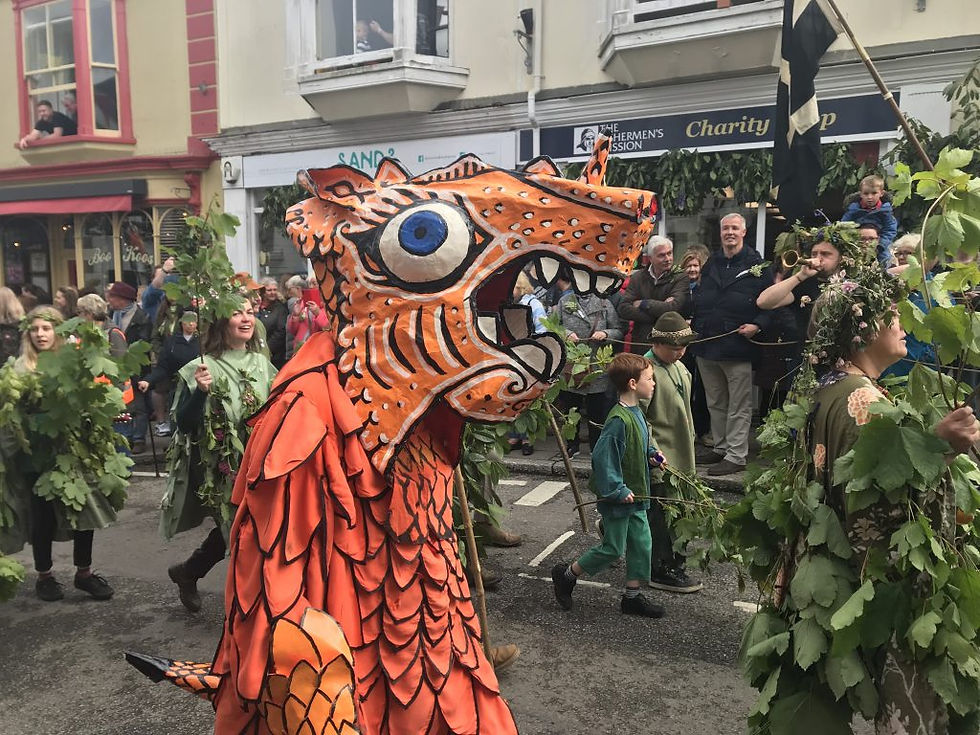
The cast is nothing short of epic - Saint George and Saint Michael appear, the Devil materialises and, crucially for us, so does the dragon.
The song gives George his traditional place:
“As for St George O
St George he was the knight O
Of all the knights in Christendom
St George he had the right O”
But Helston then stakes claim to an even greater protector:
“But for a greater than St George
Our Helston has the right O
St Michael with his wings outspread
The archangel so bright O”
During the performance, George fights the dragon while Michael confronts the Devil, bringing two of Christianity’s most famous monster fighters into the same celebratory mash-up.
The history of the custom adds another useful detail because the Hal-an-Tow fell out of favour during the Victorian period and was revived by the Helston Old Cornwall Society in 1930. Rather than weakening the tradition, that revival shows how deliberately some customs are carried forward to the present day.
Then we reach Padstow and the ‘Obby ‘Oss.
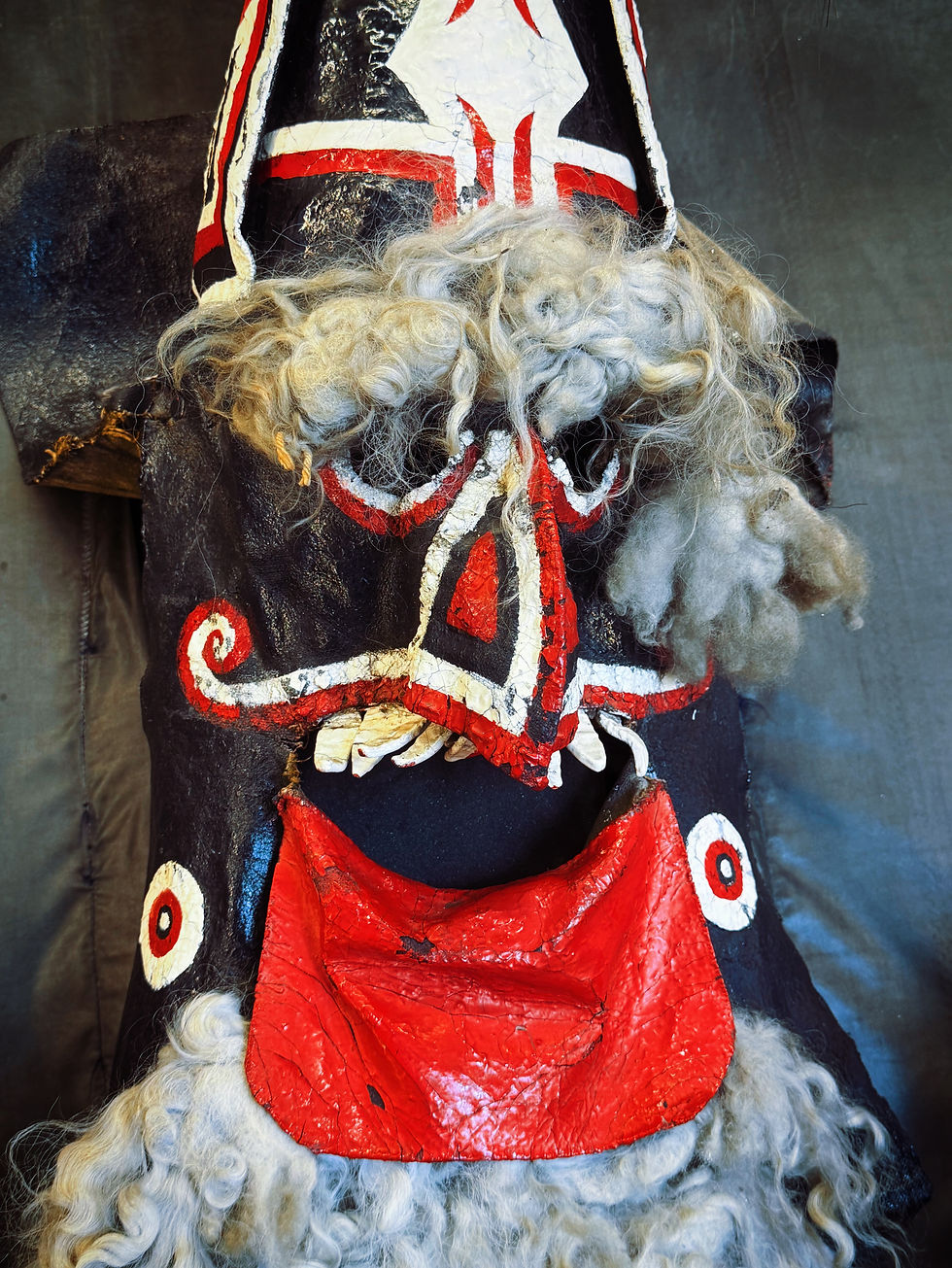
The ‘Oss is one of those creatures that becomes harder to work out what it resembles the longer you look at it! Consisting of a large black circular costume with a small snapping head, a tail and a masked performer moving through the packed streets under the direction of a teaser.
At certain points the creature collapses as though dead, the music stops, and the crowd sings a verse asking where Saint George has gone, after which the teaser brings the ‘Oss back to its feet, and the procession continues.
Folklorists Jacqueline Simpson and Steve Roud have pointed out just how unlike a horse the creature actually looks, while Simpson detected what she described as a faint suggestion of a dragon. Britain certainly had hobby dragons as well as hobby horses, and the snapping jaws, death and revival of the Padstow creature make the comparison quite logical.
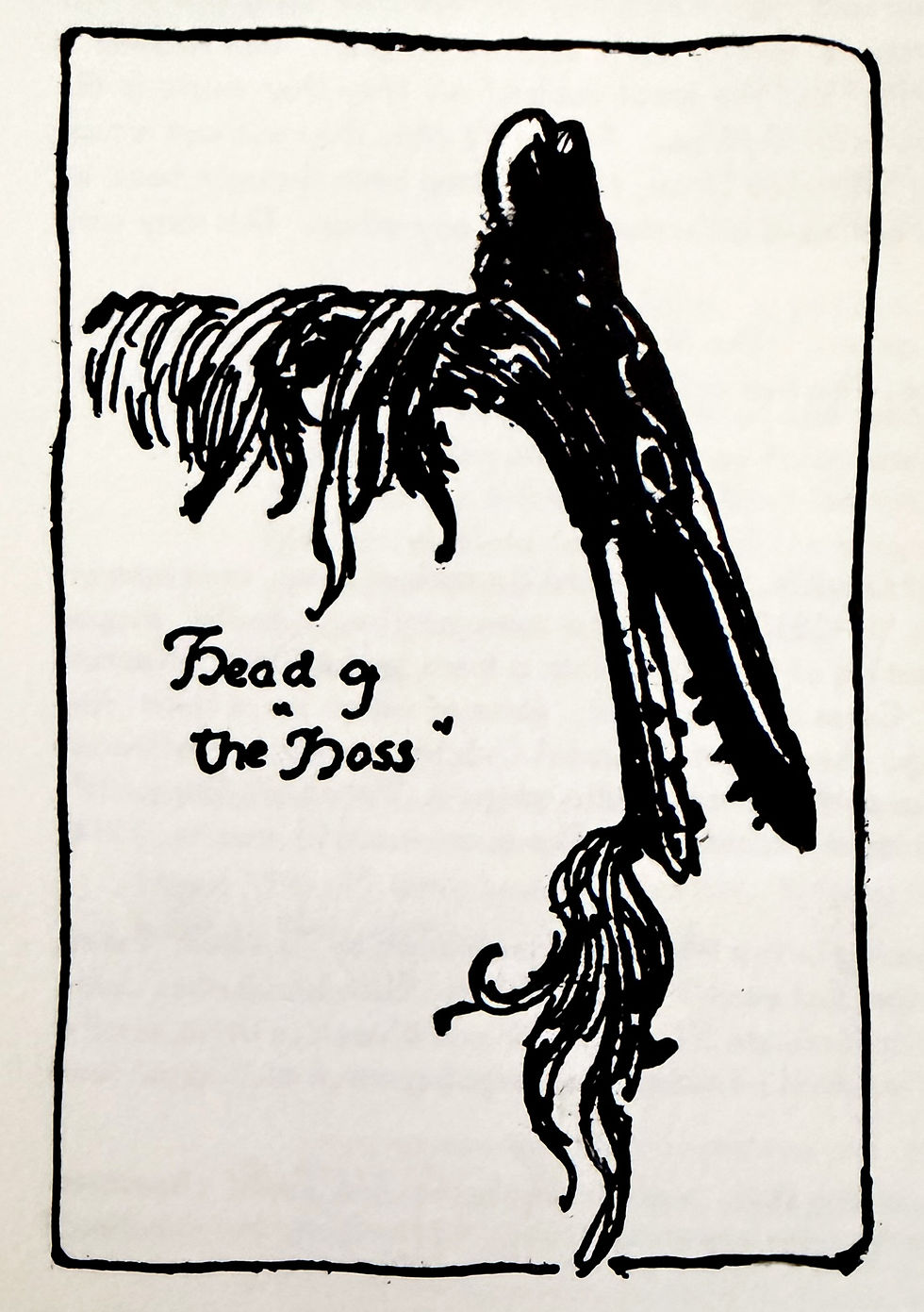
There is also a local association between Saint George and water, while the ‘Obby ‘Oss was traditionally taken to a pool where it would drink and splash people nearby.
None of that proves that Padstow’s ‘Oss is secretly a dragon, but the comparison is understandable.
Helston gives us a dragon that is unmistakable in its performance and appearance, while Padstow gives us something much stranger, but nonetheless compelling.
Trewoofe Well and the temptation of a good story
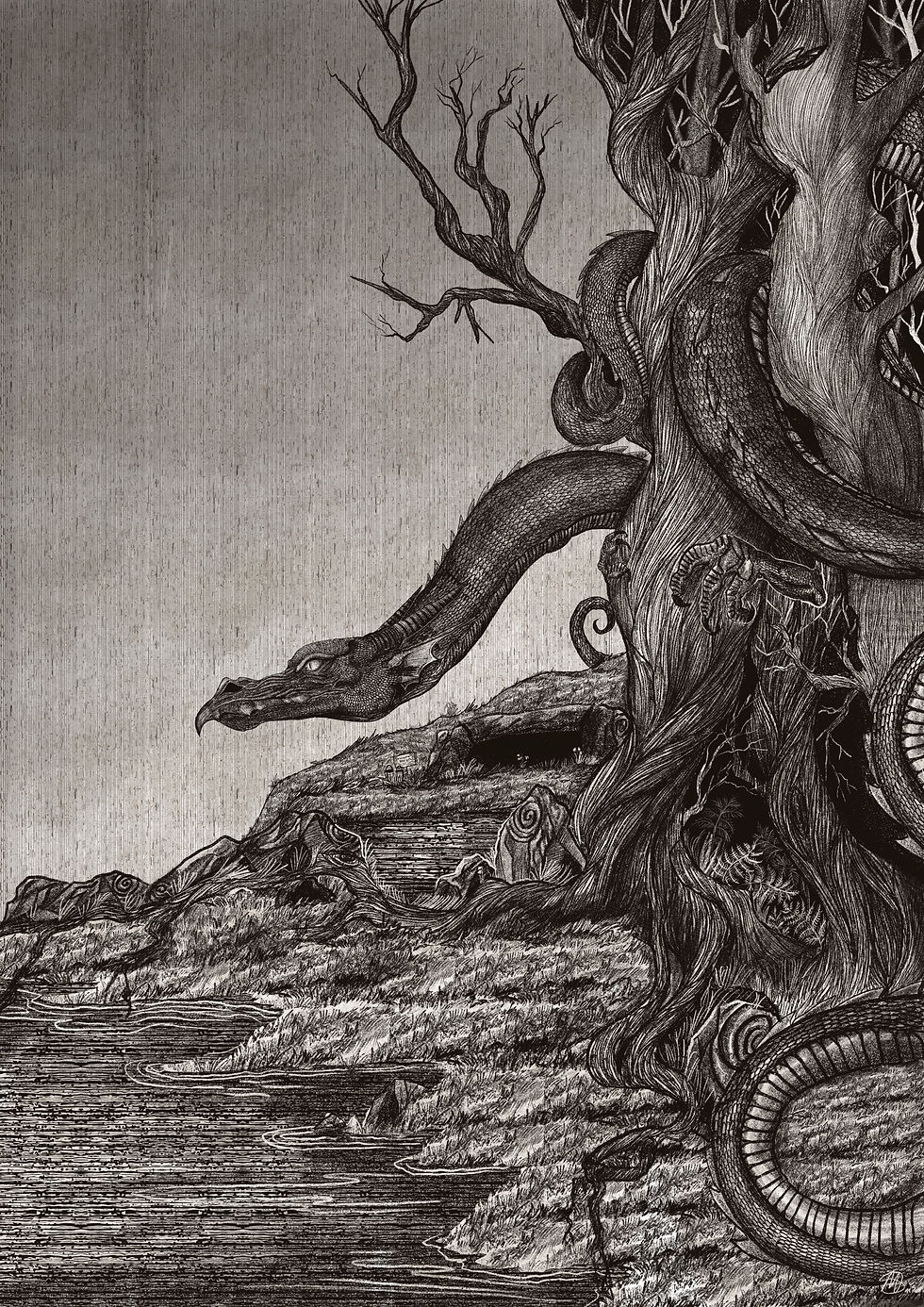
The Dragon of Trewoofe Well is usually told as a beautifully complete piece of folklore in which an emerald-scaled dragon guards a spring, demands tribute from the surrounding community and prevents villagers from reaching the water until a hero finally defeats it.
The setting of the tale itself is certainly old.
Trewoofe has a documented medieval history, and a nearby spring continues to be identified as St Ann’s Well or Trewoofe Well.
The harder part is finding an equally old source for the dragon.
The elaborate version with shimmering scales, fiery breath, desperate villagers and a heroic liberator appears readily in modern folklore writing, but it is much harder to identify an early collector or text behind it.
The broader motif is ancient enough, because dragons and serpents regularly guard springs, rivers, lakes and marshes, while Cornish wells already carry associations with saints, healing and ritual.
What makes this story useful is the contrast between a genuinely old place and a dragon tale whose age is far less clear. Once you have a medieval farm, an ancient spring and a Cornish place-name, the monster attached to them joins this fertile ground for brilliant folklore.
The dog that fought a dragon, and won!
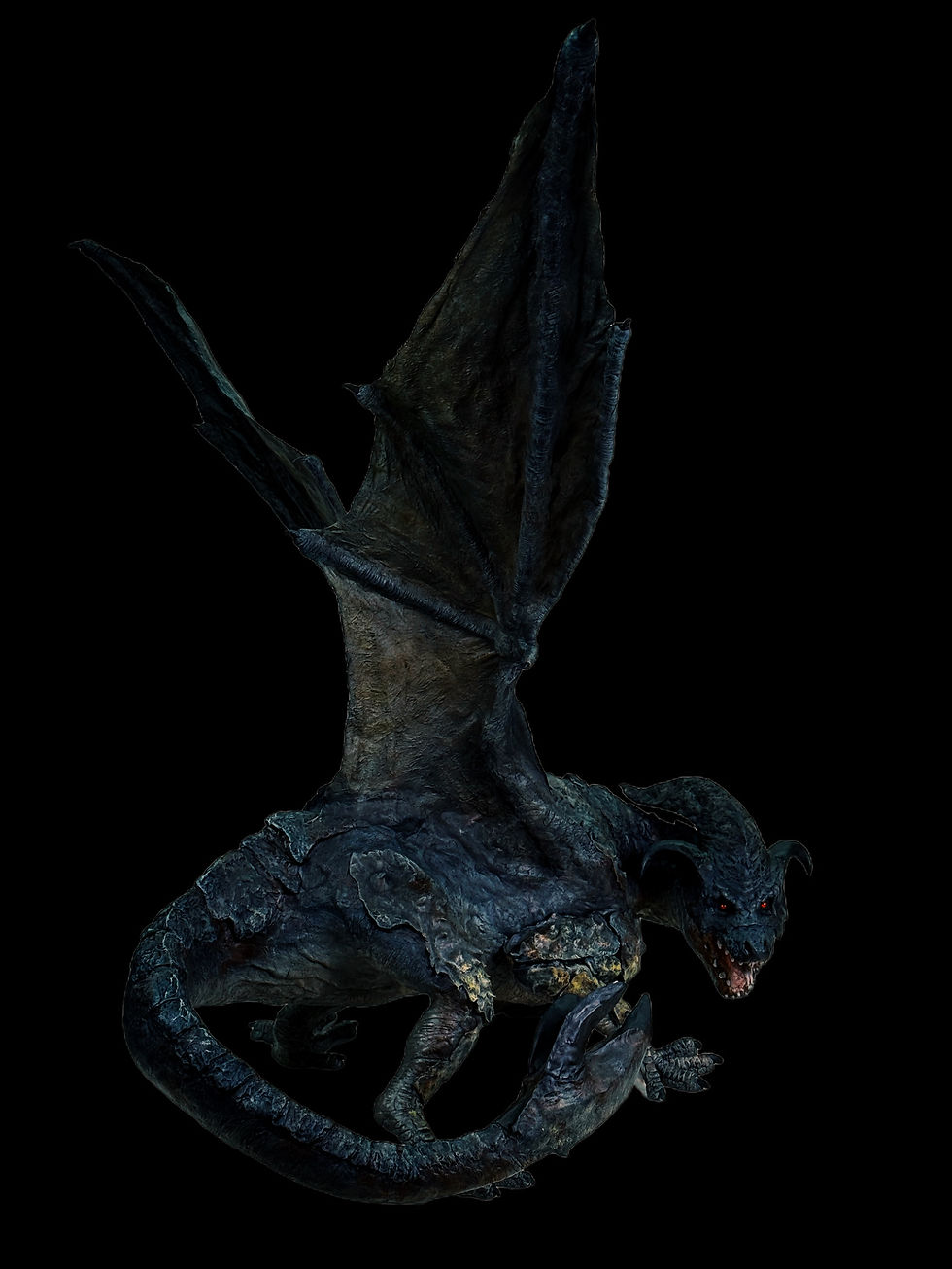
The Porthtowan story is one of the strangest in the whole collection because it removes the human hero completely and lets one beast deal with another.
A dragon is said to have lived around Mile Hill above the north coast, where it preyed on local animals until it encountered a huge supernatural hound.
The dog attacks the dragon, bites the end from its tail and drives it towards the cliffs, after which the dragon escapes out to sea and is never seen again.
Some versions describe the hound as a White Shuck. However, Shuck stories belong much more strongly to East Anglia, where Black Shuck appears as an enormous supernatural dog, sometimes with one blazing eye and occasionally with no head at all.
The modern history of the tale becomes particularly interesting during the early 1970s, when the family of magician and artist Tony “Doc” Shiels owned the Woodland restaurant at Mile Hill. Shiels persuaded them to rename it The Dog & Dragon, and his artwork depicting the local monster story appeared on signs and advertising connected with the venue.
That gave the story a physical marker on the landscape and a recognisable visual identity, while later versions continued to shift slightly between Porthtowan and nearby Portreath.
The dragon may have flown only a few miles, but even that small shift shows how fractious the geography of a legend can become!
Cornwall’s dinosaur that never existed
There is one final dragon-adjacent story worth clearing up because it still occasionally gets repeated as genuine palaeontology.
Cornwall is not especially good dinosaur country, since much of the county’s geology is considerably older than the Mesozoic rocks in which dinosaur remains are normally found.
Despite that, you may have encountered the claim that Megalosaurus footprints were discovered at the Eden Project.
On 1 April 2014, Oxford University Museum of Natural History and the Eden Project announced the discovery of a bizarre dinosaur from Cornwall, apparently represented by two nearly identical footprints that suggested the animal may have hopped around on one leg.
The supposed species was given the name Megalosaurus cornwallis-prilaeno, which becomes considerably less convincing once you say the last part aloud…
Cornwall is April one.
It was an April Fool’s joke
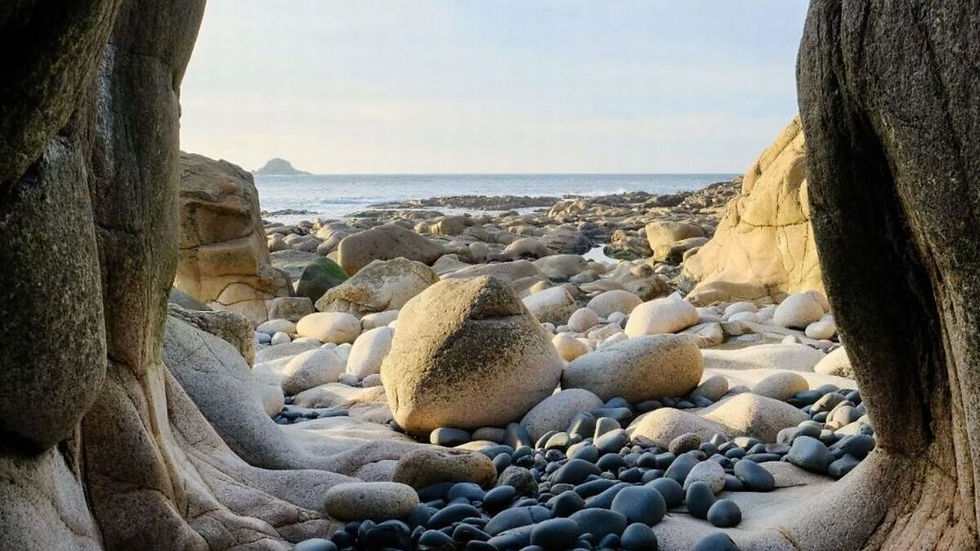
Porth Nanven has also acquired the nickname Dinosaur Egg Beach because of its huge rounded boulders, which look wonderfully prehistoric but are geological formations rather than fossilised eggs.
Cornwall may have relatively few genuine dinosaur remains, and surprisingly few dragons, but neither fact has stopped us producing good stories about them.
So what is a Cornish dragon?
By this point, I do not think there is one answer.
Petroc’s serpent comes through medieval Christian writing and is controlled rather than butchered. Saint George’s dragon arrives centuries after George himself and is repeatedly reworked through medieval devotion, Reformation politics and Protestant literature. John Michell takes the dragon out of the story altogether and turns it into a current moving beneath the countryside.
Helston gives us a dragon that only needs to exist for the duration of a public performance, while Padstow gives us a creature that may have absorbed dragon-like features without ever becoming one completely. The Stoor Worm arrives from much further north, while the Dragon of Looe may show us what a legend looks like near the beginning of its life.
Trying to make all of these creatures mean the same thing is where I think we go wrong. Not every dragon has to represent paganism, fertility, solar worship or Christianity defeating an older religion, even if some stories may genuinely contain elements of those ideas.
Sometimes the dragon is simply the most handy monster for the story being shared.
Conclusion
I started this episode wondering why Cornwall had so few dragons, but I think I ended up with a better question: how did the dragons we do have get here?
One came down from Orkney and somehow acquired the hero of the Mermaid of Zennor. Another may have emerged from a tourism webpage and is now gathering illustrations and retellings of its own. Petroc’s serpent reached us through medieval Christian writing, while Helston’s dragon survives because people still bring it into the streets and fight it.
At Porthtowan, a supernatural hound chased a dragon into the sea, and a twentieth-century artist later gave the pair another life on the sign of a restaurant. Elsewhere, the dragon stopped being an animal altogether and became Satan, political propaganda or an invisible current running beneath the countryside.
That is folklore.
Not a sealed box of stories handed down perfectly from some distant Cornish past, but something constantly being edited by the people who tell it. We preserve some stories, misunderstand others and borrow freely from traditions that may have begun hundreds of miles away.
And every now and then, we invent a new dragon and set it loose.
Sources:
Research for this article drew on Walter Traill Dennison’s nineteenth-century accounts of the Stoor Worm; William Bottrell’s Traditions and Hearthside Stories of West Cornwall; Margaret Ann Courtney’s Cornish Feasts and Folk-Lore; medieval Lives of St Petroc and St Carantoc; Andy Norfolk’s “Cornish Dragon Lore” in Meyn Mamvro; Jacqueline Simpson’s British Dragons; Alfred Watkins’ The Old Straight Track; John Michell’s The View Over Atlantis; Hamish Miller and Paul Broadhurst’s The Sun and the Serpent; records from Cornwall Heritage Trust, Historic England and Helston Town Council; and modern online retellings where these were themselves relevant to tracing how particular legends have developed.


Comments