
The Rumps
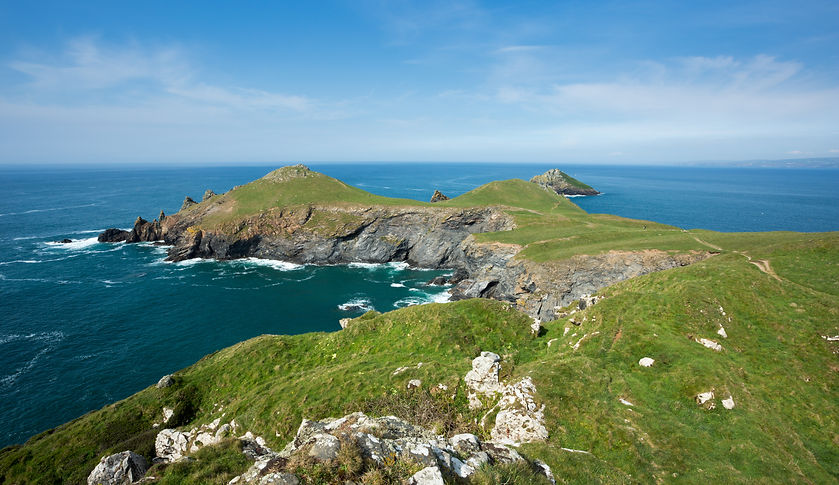

The Rumps is a double headed promontory on Cornwall’s north coast, north of Polzeath and the Camel Estuary. Formed from hard basaltic rock, it extends into the Atlantic with steep cliffs on either side. The eastern headland faces the offshore island known as The Mouls, while the western point is called Rumps Point. The site can be reached from the South West Coast Path or by an inland route from the National Trust car park at Pentire Farm. The Rumps is best known archaeologically as the site of an Iron Age promontory fort. Its narrow neck and surrounding cliffs made it a naturally strong defensive position. The fort was first recorded by John Norden in 1584 and was later shown on nineteenth century Ordnance Survey maps. Excavations between 1963 and 1967 revealed three main phases of construction and two periods of occupation, beginning in the fourth century BCE and continuing into the first century CE. The fort contained three ramparts, some cut partly into the bedrock, along with internal platforms that supported roundhouses and domestic activity. Finds included spindle whorls, loom weights, quern stones, whetstones, and animal bones, especially sheep bones. These suggest a community involved in textile production, food preparation, and livestock management. Pottery made from gabbroic clay from the Lizard Peninsula and an imported amphora show that the site also had connections beyond the immediate area. The Rumps may not have been occupied permanently throughout the year. Like other Cornish cliff castles, it may have been used seasonally or for particular social, defensive, trading, or ceremonial purposes. Its coastal position places it within a wider network of Iron Age sites linked by movement, exchange, and visibility. The effort required to build and maintain the ramparts suggests that the site held real importance for the communities who used it. Today, The Rumps forms part of the National Trust managed Pentire Headland and is also valued for wildlife. The coastal grassland, shaped by grazing, supports wildflowers, insects, and birdlife, including species of conservation concern. The surrounding sea is home to seals, dolphins, and occasional basking sharks. The headland also has literary significance, as Laurence Binyon wrote “For the Fallen” nearby in 1914, later commemorated by a stone plaque on the cliffs.
