





Joan Wytte, often remembered as the Fighting Fairy Woman of Bodmin Town, is one of the most unsettling figures connected with Cornish witchcraft and folk belief. She was said to have been born in 1775 and became known as a healer, clairvoyant, and wise woman. Tradition links her with sympathetic magic, including the use of clooties, where pieces of cloth were used in healing rituals. In her earlier life, Joan appears to have been respected for her knowledge and power, but later stories describe a dramatic change in her behaviour. According to the legend, Joan suffered from a severe tooth abscess that affected her temper and health. Her pain was said to have made her increasingly aggressive, leading to public confrontations and violent outbursts. Locals began to believe that she was possessed or under some dark influence, and her physical strength became part of her reputation. Eventually, she was imprisoned in Bodmin Jail for brawling, where the harsh and unsanitary conditions contributed to her death at the age of thirty eight. Joan’s story did not end with her death. Her remains were later exhumed and passed through troubling hands, reportedly used in séances, pranks, and occult displays before eventually being placed in the Museum of Witchcraft in Boscastle. For around forty years, her skeleton was exhibited behind glass. Visitors came to stare, point, and speculate, turning a woman once remembered for healing and power into an object of curiosity. Over time, reports of strange activity in the museum began to gather around her display, including flickering lights, moving objects, and unexplained sounds. When Graham King became curator of the museum, he decided that Joan’s remains should no longer be treated as a spectacle. With the help of Cassandra Latham, a modern Cornish witch, a séance was held on Hallowe’en to ask what Joan wanted. The response, according to those involved, was that she wished to be buried and left in peace. Her bones were removed from display, freed from their metal fixings, and placed in a wicker basket lined with wool. Offerings including brandy, tobacco, and herbs were placed with her before she was buried in a secret woodland location in 1998. The grave was marked with a simple stone recording her name, dates, and the words “No longer abused.” Since then, Joan Wytte has remained a powerful figure in Cornish folklore, modern witchcraft, and the history of how human remains have been treated. Stories still circulate about the woodland where she was buried, including chills in the air, the scent of tobacco, and whispers among the trees.

The legend of Mother Ivey’s curse belongs to the coast around Harlyn Bay, St Merryn, and Trevose Head. At its centre is a wealthy fish merchant who made his fortune from the pilchard trade. In the sixteenth century, pilchards were caught, salted, packed into barrels, and exported to Catholic Europe, where fish was in high demand during Lent and on fast days. The merchant’s house is said to have carried the motto “Dulcis Lucri Odor,” meaning “Profit Smells Sweet,” a phrase that became closely tied to the story of his greed. According to the tale, one hard season brought hunger to the local people. At the same time, a shipment of pilchards returned unsold from Italy. Although the fish could no longer be sold, they were still fit enough to feed the starving villagers. The people asked the merchant for help, but he refused. Rather than give the fish to those in need, he had them ploughed into one of his fields as fertiliser. In the story, this act of waste and cruelty becomes the cause of everything that follows. Mother Ivey was remembered as a wise woman, healer, or white witch who lived near Trevose Head and cared for the people of Padstow and St Merryn. When she heard what the merchant had done, she cursed the field where the fish had been buried. Her warning was that anyone who broke the soil would bring death upon themselves. The curse was soon said to have proved itself. Within a year, the merchant’s eldest son was thrown from his horse while riding across the field and died. From then on, the land was treated with fear. Later stories added further deaths to the field’s reputation. In the twentieth century, a man using a metal detector was said to have collapsed there from a heart attack. Soon afterwards, a water company foreman reportedly died while work was being carried out in the same ground. By 1997, when South West Water needed to dig through the field as part of its Clean Sweep programme, the curse was still taken seriously enough for the landowner to request a blessing before work began. A priest from St Columb Major was called to bless the field, and the work then went ahead without further recorded tragedy.

Alan Nance, often remembered as the Watchmaker Healer of St Austell, was a Cornish spiritual healer whose life brought together ordinary work, wartime trauma, faith, and accounts of remarkable recovery. He was born on St Mary’s in the Isles of Scilly and grew up within the Methodist traditions of chapel and Sunday School. As a young teenager, he went to sea, and during the First World War he served with the Duke of Cornwall’s Light Infantry. Near Passchendaele, he was badly injured by German artillery, an experience that affected him for the rest of his life. Between the wars, Nance lived a comparatively quiet life. He worked as a watchmaker in Plymouth and later returned to the Isles of Scilly. His path changed after time spent in Australia, where he met Bill Austen, a former editor of Psychic News. Through this connection, Nance became increasingly interested in spiritual healing and the belief that unseen forces could work through the body, mind, prayer, and intention. These ideas did not remain abstract for him. In 1956, while suffering severe pain in one of his eyes, he prayed and laid hands on himself. When the trouble disappeared overnight, he believed he had experienced something that demanded serious attention. Nance later settled in St Austell, a town he felt drawn back to after having known it decades earlier. On Trevarthian Road, he opened a small shop that was both a watch repair business and a place where people came seeking help. To passers-by, he appeared to be a quiet tradesman in a grey suit and red tie. Yet behind the ordinary shopfront, he received people suffering from pain, illness, fear, and uncertainty. He never charged for healing and described himself not as the source of power, but as a channel through which love and spirit could work. Many stories gathered around his healing practice. One account tells of a young woman who was unconscious after a car crash and opened her eyes for the first time in days after his visit. Another describes a man with advanced lymphosarcoma whose tumours reportedly began to shrink. A boy named Danny, born with a hole in his heart and too weak to live like other children, was said to have improved dramatically after treatment, becoming able to run, swim, and play. To Nance, such events were not acts of personal power, but signs of a wider force moving through life. Nance’s work was met with scepticism by some, including members of the medical profession, but he did not present spiritual healing as a replacement for conventional medicine. He believed the two could work alongside one another, each helping in different ways. His understanding of healing was inseparable from his view of death and spirit. He described death as “only a door opening” and saw healing as evidence that love, consciousness, and spiritual life endured beyond the physical world.

The story of Mr Noy and the small folk of Silena Moor comes from William Bottrell’s Traditions and Hearthside Stories of West Cornwall. It belongs to the wider Cornish tradition of people being drawn away from ordinary paths by fairy music, strange lights, and the dangers of lonely moorland. Silena Moor is described as rough, wet, and unsettling, with boggy ground, hidden springs, scrub, and thickets. The nearby Treverven Standing Stone adds to the atmosphere of the tale, marking the landscape as one where ancient monuments and fairy belief are closely linked. According to the story, Mr Noy was crossing the moor one evening when he became lost. Instead of keeping to safe ground, he followed sounds of music and saw lights moving in the gloom. These led him towards a fairy gathering near the standing stone, where the small folk were feasting, dancing, and making music. The scene appeared beautiful and lively, but like many fairy revels in Cornish folklore, it was also dangerous. What seemed welcoming could easily become a trap. Among the fairy company, Noy recognised Grace Hutchens, his lost sweetheart, who had long been believed dead. Grace warned him not to eat the food, drink the drink, or join the dancing. Any of these acts would bind him to the fairy realm and prevent him from returning to human life. She told him that she herself had been taken after tasting a golden plum, a small act that had trapped her among the fairies. Her warning gives the tale its emotional centre, turning it into a story not only of fairy danger, but of love, grief, and the cost of enchantment. When the fairies called Grace back, Noy used an old protective charm to escape. He threw an inside out glove into the gathering, breaking the spell and scattering the vision before him. The music, lights, dancers, and feast vanished, leaving him alone among the remains of an old bowjey on the moor. The beautiful fairy scene was gone, replaced by darkness, rough ground, and the silent presence of the Treverven Standing Stone. Noy had escaped, but he had also seen too much to return unchanged. Afterwards, Noy was said to have wandered the moors searching for Grace, unable to forget what he had seen. Some versions suggest that he eventually died, while others leave open the possibility that he crossed into the fairy world himself. The tale reflects several important themes in Cornish folklore: the danger of fairy food, the risk of wandering at night, the power of ancient stones, and the idea that love may endure across the boundary between worlds.

The legend of Madgy Figgy belongs to Tolpedden Penwith, near St Levan, where some of Cornwall’s most dramatic sea cliffs face the Atlantic. One of the most striking formations there is known as the Chair Ladder, a mass of great granite blocks rising above the sea. At the top is a stone shaped like a seat, and local tradition connected it with Madgy Figgy, a feared witch said to command wind, storm, and tide from this place. Madgy Figgy was not remembered as a gentle healer, but as a darker figure associated with wrecking and sea magic. The story says that when storms gathered offshore, she could be seen sitting on the stone chair, swaying as she called to the wind. With ragwort beneath her and her cloak moving in the gale, she was said to lead other witches across the sea to Wales or Spain. Her cottage near Raftra was also feared, and her name became linked with curses, hidden goods, and ships drawn into danger. The most important story connected with her tells of a Portuguese Indiaman wrecked near Perloe Cove. According to tradition, Madgy and her companions helped lure the vessel onto the rocks, where it was destroyed. No one on board survived. The bodies were stripped of valuables and buried in a hollow above the shore. Among the dead was a richly dressed woman whose clothing and jewellery marked her as someone of high status. Madgy, however, warned the others not to take her treasures, saying that the woman carried a mark of doom. The woman’s belongings were locked in a chest and hidden in Madgy’s hut beneath nets and sailcloth. That night, a strange light rose from the grave, moved along the cliff, paused by the granite chair, and then returned to hover over the chest. The same light appeared night after night for three months. Later, a silent foreign stranger arrived and asked to see the graves. Without guidance, he found the woman’s burial place, knelt beside it until evening, and then returned to the hut. He opened the chest, took only the woman’s possessions, left the rest untouched, and vanished after giving gifts in thanks. Madgy Figgy was said to have understood what the light wanted, claiming that one witch could recognise another, whether living or dead. The tale brings together several strong themes in Cornish coastal folklore: wrecking, witchcraft, hidden treasure, restless spirits, and the dangerous power of cliffs and storms. Tolpedden Penwith and the Chair Ladder remain central to the story, giving the legend a fixed place in the landscape. Some say the light can still be seen when bad weather comes in from the Atlantic, pausing near the chair...

Nelson Side was a healer from Camelford, remembered for a gift that emerged unexpectedly in middle age. He had lived an ordinary working life in north Cornwall, serving as a postman, a war veteran, a husband, and a familiar local figure. For many years there was little to suggest that he would become known for anything unusual. That changed when, in his forties, he found himself able to help people and animals through healing. The first clear moment came while he was delivering post. A woman opened the door to him with a limp caused by a badminton injury, and Nelson felt that he might be able to help. He had no formal training, ritual, or prepared method. He simply responded to an instinct and offered assistance. From that point, people began to come to him with injuries, pain, illness, and problems that had not easily been resolved elsewhere. Nelson never charged for healing. He believed that if he took money, he might lose the gift, so he treated it as something entrusted to him rather than something he owned. He often said that he was only a channel and did not fully understand how the healing worked. This plain explanation seems to have been part of the way people remembered him. He did not present himself as a showman, a preacher, or a professional healer, but as someone through whom a force beyond him might operate. Animals became especially associated with his work. Farmers called him to treat dogs, horses, cattle, and other animals, and many accounts describe them responding calmly to his presence. One story tells of a young Hereford heifer with a badly swollen leg. Nelson placed his hands on the animal and said the trouble was poison, later telling his wife that it had been bitten by an adder. The farmer reportedly found the puncture marks afterwards, and the swelling began to ease. Such stories helped build his local reputation. Nelson Side belongs to a quiet and discrete community of Cornish healers. He was not usually described as a cunning man or a formal folk practitioner, but his story feels familiar with tales of wise people and those believed to carry an unusual ability to help the sick.

Aleister Crowley is often linked with Cornwall through stories of occult practice, abandoned buildings, and strange local rumours. His reputation as one of the most controversial occult figures of the twentieth century has made it easy for later folklore to attach itself to places he may only have known briefly. Cornwall’s ancient stones, remote farms, and atmospheric coastal landscapes have encouraged speculation, but the evidence for a deep or lasting Crowley connection is limited. Crowley was in Cornwall briefly in 1938, mainly because of his connection with his son, Ataturk, who grew up in Newlyn. Beyond this, there is little firm evidence that he spent significant time in the county or that he used Cornish prehistoric sites for ritual work. Stories linking him with places such as Men-an-Tol or other ancient monuments are better treated as speculation unless supported by documentary evidence. Crowley kept extensive diaries, and these are important because they often make it possible to check where he was at particular times. In more recent years, interest in Crowley’s supposed Cornish links has been renewed by urban explorers and online videos. One abandoned farmhouse became the focus of attention after explorers filmed a pattern on the floor resembling the Sefirot or Tree of Life, surrounded by candles. The discovery encouraged rumours that the site had been used for occult practice and that Crowley might have been involved. However, while the property has been associated with him in local writing since the mid twentieth century, there is no clear evidence that he lived there or conducted rituals in the building. The farmhouse itself has become part of the legend. Its isolation, ruined condition, and surrounding landscape make it an easy setting for stories about magical activity. Crowley’s name adds further weight because of his notoriety, but that does not make the claims reliable. Some accounts have tried to connect him with a mysterious death in the 1930s, yet his diary records appear to place him elsewhere at the relevant time. This makes the darker claims especially uncertain. The link between Aleister Crowley and Cornwall is therefore best viewed as a brief scattering of a few facts and a heavy dose of rumour and modern folklore. He did have a brief personal reason to visit the county, but the stronger stories of rituals, haunted farms, and ancient stone ceremonies remain unproven.

St Ruan’s Holy Well, near Cadgwith on the Lizard, is a small but distinctive site with layers of religious history and local tradition. The well is enclosed by a Victorian structure made from serpentine, with a granite arch above it. Although the visible building is relatively recent, the spring itself may have held significance long before the nineteenth century. Like many Cornish wells, it sits at the meeting point of Christian dedication, older water traditions, local identity, and later acts of care. The well is usually connected with St Ruan, a figure whose legend includes one of Cornwall’s stranger saint stories. According to local tradition, Ruan was accused by his own wife of being a werewolf after the death of their baby and a series of attacks on livestock. He was arrested, but his innocence was said to have been proved when the king’s hunting dogs failed to react to him as they would have done to a true wolf. The story cleared him of the accusation and left him to his life to serving the people of the Lizard Peninsula. The wider area is also linked with St Rumon, another saint whose name appears in several places, including Ruan Minor, Ruan Lanihorne, and St Rumon’s Gardens in Redruth. Little is known with certainty about him, but nineteenth century antiquarian J. T. Blight recorded the tradition that his remains had once rested near Ruan before being moved to Tavistock Monastery by Duke Ordulph of Cornwall in 961. This agrees broadly with medieval references to St Rumon’s shrine at Tavistock, including William of Malmesbury’s account from the early twelfth century. Even so, some local traditions continue to place his burial at Ruan Lanihorne. The well house near Cadgwith remains a place of personal devotion today. Visitors leave prayers, thoughts, and small offerings, and a basket of tea lights has been kept there for those who wish to light a candle in memory of loved ones. A visitor’s book, stored in a tin, allows people to record their reflections. Although maps refer to the site as St Ruan’s Well, a sign inside also mentions St Garda and the Holy Cross, reflecting the dedication of the nearby church and showing how several strands of worship overlap here. Not far away, down a secluded lane, stand the ruins of St Ruan Major Church. Once regarded as one of Cornwall’s more curious and interesting churches, it now survives as a roofless and atmospheric ruin. Together, the holy well, the saint legends, the church ruins, and the surrounding Lizard landscape make this a place where folklore, archaeology, and a good swig of magic are intertwined.

The area between Nancledrea Bottoms, Trewa, and Zennor has long been linked with witchcraft traditions. Trewa was said to be a meeting place for the witches of west Cornwall, especially at midsummer. The surrounding landscape includes old tin stream works, granite boulders, wells, cairns, and prehistoric monuments, all of which helped anchor these stories to specific places. Zennor was often described in folklore as a poor and isolated parish, where misfortune was easily blamed on witchcraft. Witches were said to raise storms, damage crops, and cause sickness or bad luck. The Witches’ Rock, once said to stand between Nancledra and Zennor, was remembered as one of their meeting places. Other nearby features also carried folklore. At Embla Green, the remains known as the Giant’s House were connected with giant legends. The Giant’s Well and Druid’s Well had their own local associations, while Zennor Quoit was one of the area’s most important ancient monuments. These names show how people used stones, wells, and ruins to explain the older character of the landscape. One custom linked with the Witches’ Rock claimed that anyone who touched it nine times at midnight would be protected from bad luck. The rock has since been removed, but the tradition remains part of the folklore of the area.

Tamsin Blight, also known as Tammy Blee or Tamson, was born in Redruth in 1798. She became one of the best known Cornish pellars of the nineteenth century. A pellar was a wise woman or cunning person, often consulted for healing, charms, protection, and the removal of curses. Tamsin was believed to be connected by descent or tradition with Matthew Lutey of Cury, another well known figure in Cornish magical practice. By the 1830s, Tamsin had established a strong reputation as a cunning woman. People came to her for herbal remedies, protective charms, divination, and help against ill wishing. She was also said to predict the future, communicate with spirits, and prepare charms connected with love, healing, and good fortune. Her reputation spread across Cornwall, and she became especially associated with Helston. In 1835, Tamsin married James Thomas, also known as Jemmy Thomas, a copper miner who presented himself as a pellar. The couple lived in Helston and were consulted by fishermen, farmers, and others seeking magical or healing assistance. Tamsin’s reputation continued to grow, but Thomas became a more controversial figure. Reports linked him with drunkenness and misconduct, and after a warrant was issued for his arrest, he left Cornwall. Tamsin later distanced herself from him. Despite this scandal, Tamsin remained highly respected. Folklorist William Bottrell described her as one of the greatest Cornish conjurors of her time. People travelled from across Cornwall and the Isles of Scilly to seek her help, even when she was ill in later life. She was especially known for healing both people and animals, lifting curses, and giving advice on marriage, fortune, and protection. Stories also credited her with raising spirits, including one tale from Stithians in which she summoned a dead woman to reveal hidden money. Tamsin Blight died on 6 October 1856, but her reputation continued long after her death. She is remembered as the White Witch of Helston and remains one of the most important figures in Cornish folk magic. Her estranged husband later reappeared and died in 1874, with some accounts still calling him a wizard, but it is Tamsin whose name endured most strongly. Her story reflects a time when cunning folk played a central role in rural communities, offering remedies, spiritual protection, and guidance in moments of uncertainty.

Madron Well lies north of the village of Madron, reached by a muddy path lined with blackthorn and hawthorn. It has long been associated with healing, prayer, and local water traditions. The well once supplied the surrounding community, but it also drew people seeking cures or guidance. Today, visitors still tie strips of cloth, known as clouties, to nearby branches as part of a healing custom connected with the site. The wellhead is surrounded by rough granite slabs, which were relaid in the 1980s. Historical accounts also mention a large granite trough at the site in the early twentieth century, though this has since disappeared. The cloutie tradition remains one of the most visible parts of the well’s continuing use. A piece of cloth is tied near the water as a prayer or offering, with the belief that as the cloth decays, the illness or trouble it represents will fade. In earlier times, people visited Madron Well for specific healing rituals, especially during May. The sick were said to bathe in the water three times, walk clockwise around the well, and then rest on a nearby mound known as St Maderne’s Bed. Cloth was sometimes torn from clothing near the afflicted part of the body and tied to a tree beside the well. The well was also used for divination, including a custom in which young women floated crosses on the water and counted bubbles to predict marriage. Near the well are the remains of a small medieval chapel, usually dated to the twelfth century. The building was partly destroyed during the English Civil War, but parts of the structure and the granite altar stone survive. A stream still passes through the chapel, and until the eighteenth century this water was an important supply for Madron and Penzance. The chapel’s north entrance has sometimes been called the Devil’s Door, a feature often noted in local descriptions of the site. Madron Well and its chapel are now protected as an important historic site. The area is also valued for its plant life, including rare species such as Cornish moneywort, recorded there in the nineteenth century.
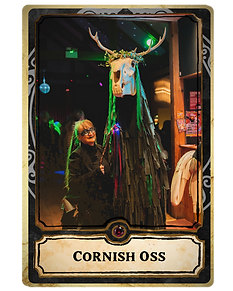
Hobby horses, or ’Obby ’Osses, are an important part of Cornish seasonal custom. They appear at events connected with midwinter, May Day, wassailing, and modern folk festivals, including Montol in Penzance and the St Ives Wassail. These figures are usually not presented as simple costumes, but as ritual beasts moved through the streets by performers. They are often accompanied by Guisers or Teasers, who guide them, provoke them, and help shape the performance. Several modern Cornish ’Osses have become well known in their own right. Morvagh the Dark Sea Oss is often seen with Boekka and Penkvyll, the Land’s End Oss. Penkvyll means “horse’s head” in Cornish. Pen Hood is another West Cornwall figure, known for its mischievous character, while St Ives now has its own Oss, Kasek Byghan, meaning “little mare” in Cornish. These newer figures show that the tradition is still active, with communities creating new beasts while drawing on older seasonal customs. Guising, also known as guise or goose dancing, is a midwinter tradition based on disguise, performance, music, and mischief. Groups would move from house to house or pub to pub, wearing masks, elaborate costumes, animal heads, horns, beaks, cloaks, long skirts, and other strange or comic clothing. They would ask for entry, food, and drink, often earning their welcome through singing, dancing, drama, music, games, or rhyming contests. The exchange could be humorous, noisy, and competitive, with insults and performance forming part of the custom. Nineteenth century accounts show that guise dancing was especially visible in west Cornwall. In 1846, the Royal Cornwall Gazette described Penzance guise dancers appearing from Christmas Day to Twelfth Day in fantastic disguises. The account also mentions a hobby horse figure with a carved wooden horse head, snapping mouth, and a cloth or hide covering the performer. Other dancers used the heads, horns, and skins of cattle. By the later nineteenth century, the custom had become controversial in some towns. In Penzance, authorities tried to suppress it, while in St Ives annual bans on disguise were repeatedly ignored. Modern festivals have helped revive and reshape these customs. Montol, held in Penzance on 21 December, brings together guise dancing, fire, music, ’Obby ’Osses, masks, mock formal dress, and processions marking the return of the light after the darkest point of the year. It is a modern festival, created in 2007, but it draws on older Cornish winter traditions. Guilds also take part, creating their own names, costumes, props, and songs. Recent examples include the Scaleybacks of Hakey Bay and other new groups, showing that Cornish guising is not only a survival from the past, but a living and evolving tradition.

The Padstow ’Obby ’Oss is one of Cornwall’s most distinctive May Day traditions. Each year, as April turns into May, the town becomes the setting for a ritual of music, movement, greenery, and community celebration. The festival begins at midnight on 30 April, when people gather outside the Golden Lion Inn to sing the Night Song. This marks the opening of the May Day celebrations and calls in the arrival of summer. By morning, Padstow is transformed. The streets are decorated with greenery, flowers, and flags, and a maypole stands at the centre of the town. The festival then fills the narrow lanes with song, drums, accordions, and crowds of Mayers following the ’Osses through the streets. The whole town becomes part of the performance, with houses, inns, families, and public spaces woven into the day’s events. Two main processions take place, each led by its own ’Obby ’Oss. The Old ’Oss is the older and more traditional figure, while the Blue Ribbon ’Oss developed later and was once associated with the temperance movement, before becoming more closely linked with peace. Each ’Oss is formed from a circular black frame covered with a dark cloak, with a mask and snapping jaws. They are accompanied by Teasers, dressed in white, who guide and provoke the ’Osses as they dance through the town. The origins of the Padstow ’Obby ’Oss are uncertain. The festival is recorded from the eighteenth century, but many have suggested that it preserves much older customs connected with May Day, seasonal renewal, fertility, and the return of summer. Some interpretations link it with Celtic Beltane traditions, while others see it as part of a wider European pattern of hobby horse customs. Whatever its earliest roots, the festival has become a living tradition shaped by the people of Padstow rather than a fixed relic of the past. For Padstow, the ’Obby ’Oss is more than a performance for visitors. It is a powerful expression of local identity, belonging, and continuity. Although the festival attracts large crowds, its heart remains with the town and the families who have carried the custom through generations. As evening falls, the ’Osses return to their stables and the final songs bring the day to a close. The festival then waits for another year, ready to rise again with the next May Day.

Anthony Nicol “Doc” Shiels was an English born artist, magician, writer, and performer whose life became closely connected with Cornwall. Born in Salford on 25 May 1938, he studied at Heatherley School of Fine Art in London and briefly at the Académie André Lhote in Paris before moving to St Ives in 1958. He arrived during an important period in British modern art and became part of the St Ives creative scene. In 1961, after Barbara Hepworth resigned, Shiels joined the committee of the Penwith Society of Arts. During his time in St Ives, Shiels ran the progressive Steps Gallery, where he showed artists including Brian Wall and Bob Law. He also exhibited his own work, with solo shows in London, including at the Rawinsky Gallery near Carnaby Street. Although he later became widely known for magic, monsters, and Fortean subjects, Shiels regarded himself first and foremost as an artist. He described his creative approach as “surrealchemy,” blending surrealism, performance, imagination, and personal mythology. In the late 1960s, after moving to Ponsanooth near Falmouth, Shiels returned to stage magic, an interest first taught to him by his father and grandfather. He wrote for magic magazines and published books including 13, Something Strange, and Daemons Darklings and Doppelgangers. These helped connect him with the world of bizarre magic. Between 1970 and 1974, he performed in Cornwall as Doc Shiels, Wizard of the West, presenting a travelling magic show that included classic illusions such as the headless woman, the sub trunk, and the buzz saw. Shiels became especially famous in the 1970s for his involvement in monster lore and publicity stunts. In 1976, he gained media attention for attempts to “raise” Morgawr, the Cornish sea monster, and for reporting sightings of the Owlman of Mawnan. These stories were covered by local and national newspapers, BBC television, Fortean Times, and other media. In 1977, he produced photographs claimed to show the Loch Ness Monster, which appeared on the front page of the Daily Mirror and became part of the wider history of modern monster folklore. Alongside these exploits, Shiels continued to write, paint, perform, and work in theatre. He founded Tom Fool’s Theatre of Tom Foolery, wrote plays, and later reflected on the events of the 1970s and 1980s in his book Monstrum. Shiels passed away in County Kerry, Ireland, on 11 July 2024 at the age of 86, leaving behind a reputation as one of the strangest and most inventive figures connected with Cornwall’s modern folklore landscape.

Aunt Alsey’s story was recorded by Robert Hunt in Popular Romances of the West of England. She was said to have lived in a small cottage at Anthony, across the Tamar from Dock, as Devonport was then known. She was an elderly woman with a fierce temper, and in a time when anger, poverty, and isolation could easily become evidence of witchcraft, the people around her came to fear her. Her landlord had tried many times to collect rent, but each visit ended in abuse. On one particular day, he crossed the river determined to claim what was owed and remove her from the cottage, but Alsey met him with such fury that he left shaken. Sitting in her doorway, she cursed him, his wife, the child his wife was carrying, and everything that belonged to him. When the landlord returned home, he told his wife what had happened. Their young daughter was also present and later became the source of the story. While the family were discussing the matter, a customer entered the shop. The landlord’s wife went through to serve her and began weighing out goods. At that moment, something heavy fell from the ceiling, struck the scales from her hand, and landed on the counter. Both women screamed. On the counter, tangled among the chains of the scales, was a large and ugly toad. The landlord fetched the fire tongs, seized the creature, and threw it behind a burning log in the parlour grate. His wife, already frightened and heavily pregnant, fainted from the shock. She recovered, but the fright brought on repeated fainting fits, and the doctor was called. He ordered her to bed and warned the family that the child might be born too soon. In the confusion, the toad was almost forgotten, until the landlord’s daughter saw it again. Burnt but still alive, it had crawled from behind the log and was struggling in the ashes near the fender. Before the landlord could remove it from the house, a man arrived from Anthony with urgent news. Aunt Alsey had fallen into her own fire, perhaps in a fit, and had been badly burnt. Her cottage had also caught fire from her clothing. The doctor and the landlord returned to Anthony and found her terribly injured. She was carried to the workhouse, but she never fully regained consciousness and died during the night. The toad, meanwhile, was thrown into the garden by the servant and found dead the next morning. When the landlord examined the toad, its injuries were said to match those suffered by Aunt Alsey...

Mên-an-Tol is one of Cornwall’s best known prehistoric monuments, partly because of the folklore attached to its holed stone. Its Cornish name means “stone of the hole,” and it has also been known locally as the Crick Stone. For centuries, people believed the stone had healing powers. Children with rickets or scrofula were passed through the hole, sometimes naked, as part of a cure. Adults with back or limb problems were also said to crawl through it in the hope of relief. The site was also linked with fairies and piskies. One tradition tells of a changeling child being passed through the stone so that the real child could be restored. This fits a wider Cornish belief that ancient stones could reverse fairy mischief or break harmful enchantments. Another custom involved crawling through the hole nine times, sometimes against the sun, as part of a healing rite. The number nine appears often in Cornish folk practice, especially in customs connected with wells, stones, and cures. Mên-an-Tol was also used for divination. Robert Hunt recorded in Popular Romances of the West of England that brass pins placed across one another on the top of the stone were believed to move in answer to questions. More recent spiritual interpretations have connected the site with rebirth, transformation, dowsing, and earth energies. These modern ideas are not archaeological evidence, but they show how the monument continues to attract ritual and esoteric meaning. Archaeologically, Mên-an-Tol stands about three miles north west of Madron, near the road between Madron and Morvah. The monument consists of three upright granite stones: the central holed stone and two standing stones on either side. The holed stone is roughly octagonal, about 1.3 metres wide and 1.1 metres high, with a circular opening about half a metre across. Nearby are other stones, some fallen or buried, along with a low cairn to the south east and further Bronze Age cairns or barrows to the north. The present arrangement is probably not the original one. William Borlase recorded the site in 1749 and showed the stones set at an angle rather than in their current straight line. Later antiquaries, including J. T. Blight and William Copeland Borlase, suggested that the stones may have formed part of a larger monument. Modern interpretation has often proposed that Mên-an-Tol was once part of a stone circle, perhaps with around eighteen to twenty stones, similar to other circles in West Penwith. The holed stone may have belonged to that circle, or it may have been moved from a nearby tomb or cairn. The wider landscape supports the idea that Mên-an-Tol was part of a rich prehistoric setting rather than an isolated monument. Mên Scryfa stands only a few hundred metres to the north, and Boskednan stone circle lies less than a kilometre to the north east. The monument probably dates to the late Neolithic or early Bronze Age, though the exact purpose of the holed stone remains uncertain. It may have framed views, marked an entrance, belonged to a burial structure, or held a ritual function now lost. Its importance today lies in the combination of archaeology, healing tradition, fairy belief, and the continuing power of a simple but striking stone form.
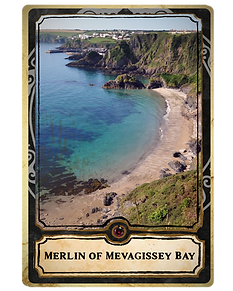
The story of Bucca Boo and the Weed of Health belongs to Mevagissey and its fishing traditions. Bucca Boo was remembered as a sea spirit, sometimes described as a kind of Neptune of the Cornish Sea. In the tale, he sent nine little men in a small moon shaped boat to gather the Weed of Health from a secret pool near the cliffs. If this boat could be brought safely into Mevagissey harbour, it was said to bring good fortune to both the person who helped it and to the village itself. The story centres on Merlin Legassick, a young boy whose grandfather, also named Merlin, still believed in the old tale. At a time when fish were scarce and the village was struggling, the younger Merlin began to hope that the enchanted boat might appear. One day, instead of gathering bait at Polstreath beach, he was drawn towards Bucca Boo’s Basin. There, among the rocks and rough water, he heard strange laughter and saw the little boat with its tiny crew trying to reach a scarlet plant growing near the cliff. The plant was the Weed of Health, but it lay beyond the little men’s reach. Merlin tried to help, but his movement startled them and the boat disappeared back into the sea. Later, the laughter returned and the boat came back. This time Merlin spoke to the helmsman and explained the hardship in Mevagissey. The little men agreed to make a bargain. If Merlin gathered the Weed of Health and left it for them, while keeping their secret, they would bring the boat into the harbour before the tide turned. Merlin kept his promise. That night, while the village slept, he climbed above Mevagissey and watched for the boat. At last he heard laughter from the quay and saw the small craft entering the harbour in the moonlight. He guided it in without waking the village, keeping the secret as he had sworn. His grandfather seemed to sense that something unusual had happened, but Merlin did not break his word. In the days that followed, the fishing improved and the village began to recover. Some people believed Merlin’s story, while others dismissed it, but the change in fortune became part of the legend.

Chapel Carn Brea, sometimes called Cornwall’s First and Last Hill, rises near the western end of Cornwall, not far from Land’s End. The hill is strongly associated with midsummer fires, old religious use, and local folklore. One of its best known figures is Harry the Hermit, who was said to have lived on or near the summit and tended the midsummer solstice beacon. These hilltop fires may have helped guide ships, marked the season, or formed part of a wider system of warning beacons along the coast. Harry the Hermit was not remembered only as a religious figure. Local tradition gives him a more difficult reputation, connecting him with anger, curses, and accusations of sorcery. One story says he cursed fishermen who failed to pay their tithes, while another claims he could raise storms when crossed. He was even said to have faced charges of sorcery from the Dean of St Buryan. Whether based on a real hermit, local tensions, or later storytelling, Harry gives Chapel Carn Brea one of its strongest folkloric associations. The hill also appears in stories of changelings and spriggans. In one tale, a mother named Jenny Trayer returned home during harvest to find her baby moved from its cradle and lying among kindling in the kitchen. After that night, the child became restless, hungry, and difficult to settle. The villagers believed that Jenny’s true baby had been taken by the spriggans and that a changeling had been left in its place. Following local advice, she carried out a series of rituals, including taking the child to Chapel Uny Well and later placing it beneath a church stile after a village rite involving brooms and ash. By morning, her real child was said to have returned, though marked by its time among the fairies. Archaeologically, Chapel Carn Brea is important because its summit contains the remains of a Bronze Age entrance grave or chambered cairn, a form especially associated with west Cornwall and the Isles of Scilly. The cairn was later reused as the foundation for a medieval chapel dedicated to St Michael of Brea, which gave the hill its name. Celia Fiennes visited the area in 1698 and described the wide views from the hill, including the sea on both sides and, in clear weather, the Isles of Scilly. The chapel survived in ruin for many years before being largely destroyed in 1816. Chapel Carn Brea also has more recent history. During the Second World War, radar installations were placed on the hill as part of the defence of the coast. Today, the remains of the cairn, chapel, and wartime activity sit within a landscape valued for its views, archaeology, and folklore.

In April 1821, Truro was part of one of Cornwall’s weirdest reported disturbances. Stones began striking the home of Sergeant Thomas Ashburn, a former soldier who had been wounded in war. The stones appeared to fall without any visible thrower, breaking windows and striking the building while nearby houses were left untouched. As the attacks continued, people in the town began to talk of witchcraft, curses, and unseen forces. The disturbance quickly drew attention. The mayor and two constables were called to investigate, but even while people watched the house, stones reportedly continued to fall. Crowds gathered in the streets, hoping to see the strange events for themselves. The regularity of the attacks, and the fact that no clear culprit could be found at first, made the case feel supernatural to many observers. Ashburn eventually moved his family to another house, hoping to escape the trouble. The disturbances followed them. In the new home, objects were said to fly across rooms and crockery was broken. The neighbouring sergeant major and his family were also affected. Fear spread further, and local people began to look for someone to blame. Suspicion fell on a local woman accused of witchcraft. Crowds followed her through the streets, believing that drawing her blood might break whatever power she held over the Ashburn family. This part of the story shows how quickly unexplained events could turn into public panic. The authorities had to deal not only with the falling stones, but also with rumours, accusations, and the risk of violence. After around six weeks, the explanation came from inside the household. Thomas Ashburn Jr, the sergeant’s sixteen year old son, admitted that he had staged the disturbances himself. He said he had thrown the stones and caused the damage after suffering abuse at home, including violence from his mother. His confession brought the events to an end, but not all were satisfied with his convenient explanation and felt supernatural forces were the real culprits.

Betty Trenoweth was remembered as a feared witch in west Cornwall. Her reputation came from her temper, her claims to hidden knowledge, and the bad luck that seemed to follow those who crossed her. One man, Dick Angwin, believed she had cursed his cattle and household after every attempt to please her had failed. His animals weakened, his affairs went wrong, and he became convinced that Betty was responsible. To break the supposed spell, Dick or someone in his household made an image of Betty from clay or dough. A long skewer was driven through the lower part of the figure as a counter charm. At the same moment, people sent to watch Betty saw her fall to the floor in agony, crying out that something was in her body. She begged for a message to be sent to Dick Angwin, saying she would make peace with him if he stopped. Fearing she might die and leave the matter worse than before, they destroyed the image and made terms with her. The punishment did not end Betty’s reputation. Another story tells how she went to Penzance hoping to buy a sow for winter. She was bargaining for one when her cousin, Tom Trenoweth, stepped in and bought it instead. Betty was furious and warned him that he would regret the purchase. Tom refused to give up the animal, and from that point the sow became impossible to manage. It escaped from its sty, damaged gardens, broke loose at night, and wandered for miles. No matter how much it ate, it became thinner rather than fatter. Tom eventually decided to take the sow back to Penzance and sell it for whatever he could get. The journey went badly from the start. At Bojew Bottom the sow refused to cross the water, threw him into the stream, and then bolted across moor, hedge, ditch, and lane. Later, near Tregonebris Downs, a hare ran across the road with a strange cry. The sow chased after it, dragging Tom with her until she bolted beneath a bridge. Tom was left torn, exhausted, hungry, and unable to move the animal. Near sunset, Betty arrived with her basket and knitting, acting as if she knew nothing. Tom accused her of crossing his path in the shape of the hare and using witchcraft to drive the sow under the bridge. She offered to buy the animal at a reduced price, arguing that it was now little more than skin and bone. Hungry and defeated, Tom accepted. Betty went to the bridge, called “Chee-ah! Chee-ah!” and the sow came out and followed her home like a dog. The tale reflects a common Cornish belief that witches could take the form of hares, and that livestock trouble or bad luck might be blamed on witchcraft.

Ann Boswell, often remembered as Granny Boswell, was a Romani wise woman associated with Helston and west Cornwall. She was born in Ireland in 1813 and married Ephraim Boswell, who was locally known as the King of the Gypsies. The couple were living in Cornwall by the 1860s and spent much of their later life around Helston and the Lizard. Their first child, Love Unity Boswell, was baptised in Bodmin in 1861, with the family’s travelling life recorded in the parish register. The Boswells made their living in several ways. Ephraim worked as a labourer, cane worker, and cabinet maker, while Ann became known for her healing, charms, and fortune telling. She was consulted as a wise woman and was especially associated with curing sick cattle. People came to her for advice, protection, and remedies, and one tradition says she prescribed a bag of black spiders hung by the bedpost as a cure for certain ailments. Granny Boswell was a striking local figure. She was said to be only about five feet one inch tall, often remembered smoking a pipe, and known for a sharp tongue. She also had repeated encounters with the law, with records showing several short imprisonments for offences such as begging or drunkenness, many of them when she was elderly. These details add complexity to her story, showing both her reputation as a respected folk healer and the hardship faced by Romani people in nineteenth century Cornwall. One well-known story places her in Helston around 1906. As she left a pub, she saw a motor car coming down the street, possibly one of the first she had encountered. Curious, she stepped into the road to look at it more closely. When the driver sounded his horn at her, she became angry and cursed both him and the vehicle, saying they would not get out of Helston. According to the tale, the car broke down before reaching the end of the road and had to be towed away by horses. Ann Boswell died in Helston Workhouse on 16 April 1909. Her funeral was widely attended, including by members of the Romani community, and she was buried at Tregerest Methodist Chapel near Sancreed. Her story remains important because it preserves the presence of Romani women within Cornish history, a group often underrepresented in written records.
