



Lyonesse is one of the most dramatic legends connected with Cornwall. It is usually described as a lost land that once lay between Land’s End and the Isles of Scilly, before being swallowed by the sea in a great flood. Later accounts describe it as a prosperous kingdom with villages, fields, roads, and 140 churches. Although there is no proof that such a kingdom existed, the story has remained powerful because it brings together folklore, coastal change, local identity, and the idea of a vanished world beneath the waves. The legend became closely aligned with Arthurian literature. In Sir Thomas Malory’s Le Morte d’Arthur, Lyonesse is named as the home of Sir Tristram, the Cornish knight whose story is tied to love, loyalty, and tragedy. Alfred Lord Tennyson later gave Lyonesse an even stronger place in the Arthurian imagination through Idylls of the King, where it becomes the setting for Arthur’s final battle with Mordred. Older Cornish accounts also helped define the legend. William Camden’s Britannia, published in 1586, recorded stories of a drowned land near Cornwall, while Richard Carew’s Survey of Cornwall, published in 1602, referred to Lethowsow, meaning the submerged lands. Carew also linked the story to the Trevelyan family, whose arms are associated with a horse escaping the flood. These early references suggest that stories of lost land and drowned places were already part of Cornish tradition before the Victorian revival made Lyonesse more widely known. The story also has a connection with real changes in the landscape. Submerged forests have been recorded around the Cornish coast, including ancient tree remains exposed at very low tides in Mount’s Bay. Geological studies also show that the Isles of Scilly were once part of a larger landmass, later reshaped by rising sea levels after the last Ice Age. This does not prove the existence of Lyonesse as a kingdom, but it does show why stories of drowned land could have taken root in coastal communities that lived with visible evidence of environmental change. Victorian writers such as Thomas Hardy and Walter Besant helped keep the legend's fire burning, while later artists, poets, musicians, and storytellers have continued to reinterpret it. Today, Lyonesse can be read as folklore, literature, environmental tragedy, and Cornish cultural identity. Whether Lyonesse is a myth, history, or a combination of both, it is one of Cornwall’s most compelling stories of a world lost to the sea.

The Whooper of Sennen Cove is one of the stranger pieces of folklore from the far west of Cornwall, close to Land’s End. The story tells of a mysterious presence that appeared when the weather seemed calm and clear. Even on fine days, a thick mist could suddenly gather over the cove, bringing with it a strange whooping sound. This sound was believed to be a warning rather than a threat. Local tradition held that the Whooper could predict storms. When bad weather was approaching, the mist and the cry would prevent fishermen from putting to sea. In this way, the Whooper was seen as a guardian of the cove, protecting local people from danger even when the sky still looked harmless. The warning was especially important in a place where fishing lives depended on reading sudden changes in wind, water, and weather. One tale says that two fishermen once ignored the warning. Determined to reach the open sea, they forced their way through the mist despite the strange sounds around them. They succeeded in leaving the cove, but neither they nor the Whooper were ever seen again.

Morgowr is Cornwall’s best-known modern sea monster, most closely linked with Falmouth Bay, the Helford River and nearby coastal waters. The name comes from Cornish and is usually translated as “sea giant”. Although Morgowr became famous in the 1970s, the creature belongs to a much longer pattern of Cornish sea monster sightings, with widely recorded reports appearing in the nineteenth century. One of the earliest major accounts was printed in January 1877, when the West Briton carried a report concerning Captain Drevar of the ship Pauline. Drevar claimed to have seen a sea serpent on three separate occasions, including an animal that followed his vessel and appeared to catch whales. Further reports followed in the early twentieth century. In 1903, Captain White of the Falmouth tug Triton described a serpent around one hundred feet long near Longships lighthouse, and in 1906 witnesses aboard the liner St Andrew reported seeing a sea serpent off Land’s End. These earlier sightings formed the background to the later Morgowr legend. By the 1970s, reports around Falmouth Bay and the Helford River gave the creature a clearer local identity. In September 1975, Mrs Scott and Mr Riley reported seeing a humped creature with a bristled neck and short horn like projections off Pendennis Point. In March 1976, the Falmouth Packet published two grainy photographs sent anonymously by “Mary F”, said to show a dark shape in the water near Trefusis Point, with humps and a raised neck. More Morgowr sightings followed from Rosemullion Head, Grebe Beach, Gyllyngvase, and the Helford River. Fisherman George Vinnecombe and John Cock gave one of the best known accounts in July 1976, describing a creature as large as their boat with a head raised on a long neck. Artist, magician, and showman Tony “Doc” Shiels also became closely associated with Morgowr, helping to shape its public image through his photographs, claims, and theatrical involvement in the creature’s story. Explanations have ranged from misidentified seals, whales, debris, and hoaxes to the possibility of an unknown marine animal.
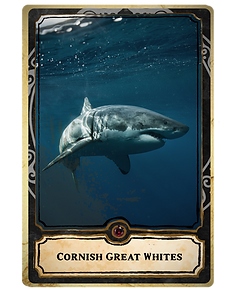
The question of whether great white sharks have ever visited Cornish waters has interested fishermen, marine researchers, and the public for many years. Cornwall has a rich marine environment, with seals, fish, and deep coastal waters that can attract large predators. However, despite repeated claims and occasional media attention, there is still no confirmed record of a great white shark in Cornwall. One of the best known reports came in 1999, when the crew of the fishing vessel Blue Fox claimed to have seen a large shark off Cambeak Head near Crackington Haven. They described it as around 15 feet long, with a bright white underside. The crew were familiar with local species such as porbeagles, makos, and basking sharks, and their captain, Mike Turner, had experience of great whites from time spent in South Africa. A second report followed the next day, when another fishing crew said a large shark bit part of a tope shark they were hauling in nearby. Other reports followed in the early 2000s. A young witness near Baggy Point claimed to have seen a shark resembling a great white among a shoal of fish, though no one else confirmed the sighting. In 2007, footage from St Ives appeared to show a large shark breaching among dolphins off Porthmeor Beach, but experts later identified it as a basking shark. Another supposed image from Newquay was later revealed to have been taken in South Africa, making it a hoax rather than evidence from Cornwall. There are reasons why people continue to find the idea possible. Great whites are known to travel long distances, and Cornwall’s coast has large seal colonies and water temperatures that may not be impossible for the species. Even so, possible conditions are not the same as confirmed presence. Many large sharks found around Britain, including porbeagles, basking sharks, and other species, can be mistaken for great whites, especially when seen briefly from a boat or cliff. The legend of Morgawr, the sea creature said to inhabit the waters around Falmouth Bay, adds a folkloric layer to these reports. Some local stories jokingly connect Morgawr with the absence of confirmed great whites, but the scientific position remains straightforward: there is no clear photograph, carcass, tooth, genetic sample, or verified sighting proving that a great white has entered Cornish waters. For now, Cornwall’s great white shark stories remain a mixture of credible eyewitness claims, misidentification, media excitement, hoaxes, and maritime folklore.

The wreck of the St Chamond lies about 1.75 miles north of St Ives Head, in roughly 27 metres of water. It is officially charted as the St Chamond and rises around 6 metres above the seabed at its highest point, where the tops of the upright boilers remain visible. The wreck rests on a pebbled seabed and includes the remains of the collapsed hull, propeller shaft, triple expansion engine, boilers, rudder, and steel propeller. The St Chamond is especially significant because of its cargo. Wartime records state that the vessel was carrying five locomotives, but divers have since recorded at least six and possibly seven. Some lie upright, while others are on their sides or separated from their bogeys. These locomotives were being transported as part of the broader military logistics of the First World War, when rail transport was crucial for moving men, equipment, and supplies to the front. The wreck has also produced a range of artefacts and recovered material. Salvage records include valves, electric motor parts, 40 by 20 millimetre shells, water sight glass tubes, and other components. A sounding weight has also been reported, and several finds have been logged through official wreck reporting. These objects help show the mixed character of the site as both a wartime loss and an underwater record of early twentieth-century engineering. Recent dives have added further importance to the wreck. Two locomotives rediscovered on the site have been identified as the only known surviving examples of their type. This makes the St Chamond more than a shipwreck. It is also a rare submerged archive of industrial transport, military supply, and wartime technology. The locomotives, engines, and machinery now form part of a scattered but highly significant underwater landscape. The sinking of the St Chamond reflects the risks faced by merchant shipping during the First World War. Although the vessel was strongly built, with a screw-driven triple expansion engine and substantial deck structures, it was vulnerable to submarine attack. The ship was sunk by U60, leaving its cargo of locomotives on the seabed off the Cornish coast. Today, the wreck remains an important site for maritime archaeology, diving history, and the study of wartime supply routes.

The Seven Stones reef lies between Land’s End and the Isles of Scilly. It is both a dangerous maritime hazard and a place strongly connected with Cornish legend. Geologically, the reef forms part of the Cornubian granite batholith, created more than 275 million years ago. It rises sharply from deep water and stretches for nearly two miles. At low tide, named rocks and ledges such as Pollards Rock, Flemish Ledges, and the Town can be seen breaking the surface. The reef has long been feared by sailors. More than 200 wrecks are thought to lie in its waters, including the Primrose in 1656 and HMS Lizard in 1748, which sank with the loss of more than 100 lives. To reduce the danger, a lightvessel was placed near the reef in 1841, positioned in calmer water to the north east. The lightship has survived storms, collisions, and wartime attacks, and since 1987 it has operated as an automated and unmanned station. The Seven Stones is also closely linked with the legend of Lyonesse, known in Cornish as Lethowsow. This lost land was said to have stretched between Cornwall and the Isles of Scilly before being swallowed by the sea. In folklore, the reef is often described as the last visible remains of that drowned country. The Cornish name Lethowsow has been interpreted as “the milky ones,” referring to the white water that constantly churns around the rocks. Medieval and early modern writers helped preserve the story of a drowned landscape. Florence of Worcester recorded a great flood in 1099 that drowned towns and livestock, while later writers such as Richard Carew repeated local claims that fishermen had pulled pieces of doors and windows from the sea. Antiquarians also recorded traditions that people could hear the bells of a drowned city beneath the waves, or see walls and field boundaries below the water in clear conditions. In modern history, the reef became internationally known through the wreck of the supertanker Torrey Canyon in March 1967. The ship struck Pollards Rock, causing a major oil spill that polluted long stretches of the Cornish and Brittany coasts. It was one of the worst oil pollution disasters in British history and confirmed the Seven Stones as a place of real maritime danger. Today, the reef remains significant for its geology, shipwreck history, navigation, and its lasting connection with the legend of Lyonesse.

A strange legend from the coast near Land’s End tells of a Chinese princess murdered after a disastrous voyage to Cornwall. According to the story, she had been sent by the Emperor of China to present two Pekingese dogs to Queen Elizabeth I. The dogs were said to be a royal gift, accompanied by the princess, a mandarin protector, servants, bodyguards, and a quantity of gold. By the time the ship neared England, disease, piracy, violence, and hardship had reduced the party to only a few survivors. When the group reached Cornish waters, they transferred to a local fishing boat to make landfall. The Cornish crew were said to have feared the foreign princess and mandarin, believing them to possess dangerous powers. They had also heard rumours of treasure. Fear and greed led to mutiny. The captain, mandarin, and remaining servant were killed, and the princess was thrown into the sea. The fishermen searched for the gold but found only an ivory casket containing the Pekingese and their puppies. When one sailor reached inside, he was bitten badly by the dogs and later died. The casket was thrown overboard, but a storm carried it and the princess’s body into a lonely cove near Land’s End. There, a local man found them washed ashore. The man opened the broken casket and discovered the dead female Pekingese and her puppies. Hidden in the princess’s sleeve was the surviving male dog, weakened but still alive. Moved by the scene, the man buried the princess and the dogs together on the shore and planted daisies in the shape of a cross over the grave. The little dog died beside its mistress, sealing its place in the legend as her faithful guardian. Later tradition claims that the ghost of the Pekingese still protects the princess’s grave. Anyone who tries to find or disturb the burial place is said to risk death, and some versions warn that a bite from the phantom dog is fatal.

The Isles of Scilly were once part of a much larger landmass. Before and after the last Ice Age, changing sea levels gradually reshaped the area, turning higher ground into the islands seen today. As the sea rose, lower valleys, plains, and possible routes between the islands were covered. This changing landscape has helped inspire stories of lost land, drowned settlements, and ancient causeways beneath the water. Older accounts suggest that people were aware of these submerged features. An eighteenth century report described what appeared to be a paved causeway lying under shallow water. Even in the third century AD, the Roman writer Solinus referred to Scilly in the singular, using insulam Siluram, which may suggest that the islands were remembered or understood as a single place. This does not prove that Scilly was still one island at that time, but it shows how ideas about its former unity have deep roots. In 1927, O. G. S. Crawford, the first Archaeology Officer of the Ordnance Survey and founder of Antiquity, argued that the Isles of Scilly may once have formed a single landmass. He also linked the islands with the legend of Lyonesse, the drowned country said to lie between Cornwall and the open sea. This connection remains speculative, but it reflects the long association between the Scillies, rising seas, and stories of land lost beneath the Atlantic. Some writers have also connected the Isles of Scilly with the Cassiterides, or Isles of Tin, mentioned by classical authors such as Pliny the Elder. No tin is known on the islands today, but it has been suggested that deposits may once have been exposed before sea levels rose. This remains uncertain, and there is no firm evidence that Scilly was the tin island of classical tradition. Even so, the idea shows how the islands have often been placed within wider stories of trade, metal, and ancient maritime contact. Modern underwater discoveries continue to renew interest in these questions. Divers from the Cornwall and Isles of Scilly Maritime Archaeology Society, working with local diving groups, have recorded a granite feature on the seabed that resembles a paved causeway, although it may be natural. Other theories, including claims that Atlantis lay on the Celtic Shelf near the Isles of Scilly, remain outside mainstream archaeology.

The wreck of the Schiedam lies off Dollar Cove at Gunwalloe on Cornwall’s Lizard Peninsula. The ship was originally a Dutch cargo vessel, or fluyt, before being captured by Barbary pirates and then retaken by the Royal Navy. After this, she became known as the Schiedam Prize and was used as a transport ship. In 1684, while carrying people, horses, cannon, and military stores from Tangier, she was separated from her convoy in a gale and wrecked on the Cornish coast. The wreck remained hidden for centuries beneath sand and surf. It was first identified in 1971 by diver Anthony Randall, who began long-term archaeological work on the site. Since then, more than 150 artefacts have been recovered, many of which are now held at the Charlestown Shipwreck and Heritage Centre. More recent work by divers, including Mark Milburn and David Gibbins, through Cornwall Maritime Archaeology and Historic England, has helped record the site and monitor its condition. The finds from the Schiedam show the military nature of her final voyage. Artefacts include cannons, gun carriage fragments, hand grenades, and other equipment. Some grenades have even been found washed ashore near Dollar Cove centuries after the wreck. At first, they can look like ordinary encrusted stones, but several were later identified and safely dealt with by the British Army. These objects give a direct link to the ship’s cargo and the wider military events connected with Tangier. The site is fragile because it lies in a highly active coastal environment. Much of the ship’s wooden structure has decayed, but storms sometimes strip away the sand and expose cannon, ironwork, and other remains before covering them again. This makes the wreck difficult to study, as each storm can reveal new material while also causing further damage. The shifting seabed means that the Schiedam is both an important archaeological resource and a vulnerable maritime site. The Schiedam is now protected as a designated wreck site by Historic England. Its significance lies in the unusual journey of the vessel, from Dutch merchant ship to pirate prize, naval transport, and wreck on the Cornish coast.

Looe Island is a nine hectare marine nature reserve off the south coast of Cornwall. It has been managed by Cornwall Wildlife Trust since 2004 and is protected for its wildlife, habitats, and historic landscape. The island supports seals, dolphins, seabirds, grassland, woodland, rocky shore, and reef habitats. Access is carefully controlled to protect this fragile environment, with visitors usually landing only through organised boat trips between spring and autumn. The island is also known by its older name, Lammana, and its history reaches far beyond its present role as a nature reserve. On the northern side stands a solitary stone, sometimes suggested to have prehistoric origins. Finds from the island and surrounding waters show that this was not an isolated place in the past. Its position off the Cornish coast made it part of a wider maritime world, connected by sea routes, trade, religion, and local settlement. One of the most debated ideas linked with Looe Island is its possible connection with Ictis, the tin trading island described by classical writers. Pytheas, writing in the fourth century BC, and later Diodorus Siculus, described a place where tin from Belerion was taken across dry ground at low tide before being sold to merchants. Most scholars identify Ictis with St Michael’s Mount, but finds near Looe Island, including a large bronze ingot and imported amphora fragments, show that the area was connected to trade in the late prehistoric, Roman, and post Roman periods. Classical accounts describe tin being extracted, smelted, and cast into ingots before being transported for sale. Whether or not Looe Island was Ictis, the evidence points to the island’s place within long distance exchange networks. Objects recovered from the area suggest links beyond Cornwall, including contact with the Mediterranean world. Over time, the island’s identity appears to have shifted from trade and maritime activity towards religious use, reflected in the name Lammana and its associations with an early Christian enclosure or monastic site. The first firm documentary reference to Lammana comes in 1144, when Pope Lucius II confirmed the island as a possession of Glastonbury Abbey. This was reaffirmed in 1163 by Pope Alexander III. By around 1200, a small priory had been established on the island, occupied by two monks. Its chapel was dedicated to St Michael and became a place of worship and pilgrimage. The monks also held property on the mainland and carried out religious duties for people around Portlooe, although such pastoral work was unusual for Benedictines. By 1289, Glastonbury had withdrawn from Lammana and sold the chapel and its holdings to Walter of Treverbyn, lord of Portlooe. The island then became a secular benefice under the parish of Talland. The chapel continued in use into the sixteenth century, but its income was modest and services became limited. By 1546, worship on the island had ceased, and in 1548 the Crown dissolved the benefice and sold the island and chapel into private ownership.
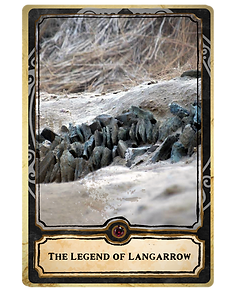
The legend of Langarrow, also known as Langona or Langurroc, belongs to the dunes between Crantock and Perranporth. Tradition says that a wealthy city once stood beneath the sands, before it was buried by a violent storm around 900 years ago. The city was said to have been one of the greatest in England, with seven churches, rich trade, mining wealth, and a harbour connected with the Gannel. The story presents Langarrow as a place of prosperity that fell into moral decline. Criminals from across Britain were supposedly sent there to work in the mines and help build its harbour. At first they were kept apart from the citizens, but over time they became part of the community. Later versions of the tale claim that this led to corruption, and that divine judgement came in the form of a sandstorm lasting three days and nights. The legend is also connected with Crantock, once an important religious centre. Some accounts suggest that the destruction of Langarrow contributed to the decline of the older settlement and its church community. Like other Cornish stories of drowned or buried places, the tale may reflect real environmental change, especially the movement of sand across the north coast. Dunes can cover fields, boundaries, buildings, and roads, leaving later generations to wonder what lies beneath. Recent storms have occasionally exposed stone walls and other features on Crantock beach, renewing interest in the story. These remains have been interpreted by the National Trust as old Cornish hedges or field boundaries, probably visible on maps from the late nineteenth and early twentieth centuries. Although they are unlikely to be evidence of a lost medieval city, their appearance after shifting sands gives the legend renewed force.

The story of Lutey and the mermaid is one of the best known Cornish tales connected with the Lizard. It tells of a farmer, fisherman, and smuggler named Lutey, who lived near the shore and one evening found a stranded mermaid among the rocks at low tide. Her name was Morvena, meaning sea woman, and she begged him to carry her back to the water before the tide turned and her hungry merman husband awoke. In return for his help, Morvena promised Lutey three wishes. Rather than ask for riches, long life, or power for himself, he wished for the ability to break witchcraft, command familiar spirits for useful knowledge, and pass these gifts down through his family. The mermaid agreed, and gave him a golden comb as a token, saying that if he ever needed her guidance he should pass it through the sea three times and call her name. As Lutey carried her towards the waves, the mermaid tried to tempt him into joining her beneath the sea. She described underwater halls filled with coral, amber, pearls, jewels, sunken treasure, and the preserved bodies of drowned men and women. Her voice and beauty almost overcame him, but the barking of his dog broke the spell. Seeing his home, land, and family behind him, Lutey resisted her and forced her to release him. Although they parted badly, Morvena kept her promise. Lutey became known as a powerful pellar, or cunning man, able to undo charms and help those afflicted by witchcraft or other troubles. His wife, despite being told to keep the encounter secret, spread the story through the parish, and people soon came to him for help. The tale explains the origin of a line of Cornish magical practitioners whose knowledge was believed to have come from the sea. The mermaid’s favour came at a cost. Nine years after the encounter, Lutey was fishing on a calm moonlit night when the sea suddenly rose around his boat. Morvena appeared in the waves, and Lutey knew his time had come. He leapt into the water, swam beside her, and vanished beneath the surface. His body was never found, and the story says that every nine years one of his descendants is claimed by the sea.

The legend of the Doom Bar is one of Padstow’s best known coastal stories. It tells of Tristram Bird, a young hunter from Padstow, who went out one morning with his gun and wandered towards Hawkers Cove. There, beside a quiet pool, he saw a beautiful woman singing by the water. Captivated by her appearance and voice, he approached her and asked her to become his wife. The woman refused him. In some versions, she teased him gently, while in others she warned him more directly. Tristram’s pride turned to anger, and he threatened to shoot her if she would not come with him. Before he fired, she warned that if he killed her, Padstow would suffer. A bar of sand would rise across the harbour, ships would be wrecked, and her voice would be heard mourning the dead. Tristram ignored the warning and shot her. As she fell into the pool, he saw that she was not an ordinary woman but a mermaid, her lower body ending in a silver tail. Realising what he had done, he fled back towards Padstow. According to the legend, a strange line of sand began to appear across the water between Hawkers Cove and the far side of the estuary, marking the beginning of the Doom Bar. The next morning, after a violent storm, the people of Padstow found their harbour changed. A dangerous sandbank now lay across the mouth of the Camel Estuary, making navigation far more hazardous. Wrecks later became part of the Doom Bar’s reputation, and the legend explained this danger as the result of the mermaid’s curse. Her cry was said to be heard on stormy nights whenever ships were in peril.

The Mermaid of Zennor is one of Cornwall’s best-known sea legends. The story centres on St Senara’s Church in the village of Zennor, near the coast road between Land’s End and St Ives. According to tradition, the church once had a gifted young singer named Matthew Trewella, whose voice was so beautiful that people came to hear him sing the final hymn alone. Among those drawn to his singing was a mysterious woman of striking beauty, who appeared in the church from time to time. The woman’s visits were irregular, but whenever she came, the congregation took notice of her beauty and her extraordinary singing. No one knew where she came from or where she went after the service. Matthew eventually noticed her, and one day followed her from the church towards the sea at Pendour Cove. He never returned, and the woman was not seen again in Zennor Church. The explanation came later, when a ship anchored near Pendour Cove. A mermaid rose from the water and asked the sailors to lift their anchor because it was resting on the door of her underwater home. In some versions, she said she needed to enter so she could care for her children. The sailors, believing mermaids to be dangerous omens, quickly raised anchor and left. When the people of Zennor heard the story, they concluded that the beautiful church visitor had been a mermaid and that Matthew had gone with her beneath the sea. The legend was recorded by William Bottrell in the nineteenth century, although the story may be older. Some modern interpretations suggest that the carved mermaid in St Senara’s Church may have inspired the tale rather than commemorated it. Mermaids were common in medieval church imagery, often representing vanity, temptation, or the divided nature of earthly and spiritual life. Their familiar symbols, including combs and mirrors, appear in churches across Britain and Europe. The object most closely linked with the story is the Mermaid Chair in St Senara’s Church. It is an old wooden seat made from earlier bench ends, with carved sides believed to be several centuries old. One side carries interlaced decoration, while the other shows a mermaid holding a comb and a mirror. Whether the carving inspired the legend or was later understood through it, the Mermaid Chair remains one of Cornwall’s most important folkloric artefacts and the lasting focus of the Zennor mermaid story.

Bucca Dhu, or the Black Bucca, represents the darker side of the Bucca in Cornish folklore. It was remembered as a dangerous spirit connected with storms, fear, caves, lonely places, and bad fortune. While the Bucca could sometimes help coastal communities, Bucca Dhu belonged to its more threatening form, the one people feared if customs were broken or respect was not shown. Around west Cornwall, the Bucca was closely associated with the weather. In the Penzance area, storms blowing in from the south west were sometimes described as “Bucca calling,” as though the spirit’s voice could be heard in the wind. This connection with storm sound, sea danger, and sudden change made Bucca Dhu a natural figure of warning for fishing communities whose lives depended on reading the sea. Bucca Dhu also appears in stories where the spirit punishes disrespect. In the tale of the Bucca of Newlyn, a sea Bucca who once helped fishermen became enraged when given unsuitable offerings. Instead of fish, the people left cakes and baked food on the shore. The spirit rejected them, turned into Bucca Dhu, and raised a storm that kept the fishermen from going to sea. In later tradition, Bucca Dhu was also linked with the idea of the Bucca-boo, a frightening figure used to scare children into behaving. Parents warned that Bucca-boo would come for children who cried too much or misbehaved. This shows how a coastal and storm spirit could also become part of household folklore, turning into one of Cornwall’s old bogeyman figures. Bucca Dhu remains important because it shows how Cornish folklore often treated supernatural beings as unpredictable rather than simply evil. The Black Bucca was frightening, but its anger usually had a cause, such as neglect, insult, or broken custom. It guarded the dangerous edge between people and the unseen forces of sea, weather, underground places, and old beliefs.

Bucca Gwidden, or the White Bucca, was remembered as the more helpful form of the Bucca in Cornish folklore. Unlike Bucca Dhu, which was associated with storms and fear, Bucca Gwidden could bring luck and assistance when treated with respect. It was especially connected with fishing communities in west Cornwall, where offerings were left to keep the spirit favourable. Fishermen in places such as Newlyn and Mousehole were said to leave part of their catch on the sand at night for the Bucca. These offerings were intended to maintain good relations with the spirit and to encourage success at sea. The practice suggests that Bucca Gwidden was seen not only as a supernatural presence, but as part of the working life of coastal communities. One Newlyn tradition describes a sea Bucca who helped local fishermen by driving fish into their nets. At sea he had a fish tail, but when he came ashore it became legs. His skin was leathery and brown like a conger eel, and his hair was made of bladderwrack. Because he helped the fishermen, they called him Bucca Gwidden and tried to honour him with gifts. The story also shows that even the White Bucca had to be understood properly. When the people offered him cakes and other land food instead of fish, he became angry and changed into Bucca Dhu. This detail is important, because it shows that benevolent spirits in Cornish folklore still required respect, knowledge, and the right kind of offering. Bucca Gwidden represents the protective and generous side of the Bucca tradition. It helped fishermen, supported good fortune, and could be friendly towards people when old customs were observed. Yet it was never harmless in a simple sense. Like the sea itself, Bucca Gwidden could provide abundance, but only if approached with care and respect.

Porthcurno is best known for its pale sand, clear water, and dramatic coastal setting, but it also has a darker strand of folklore. One local legend tells of a ghostly ship seen near the cove after dusk. Robert Hunt described it as a black, square-ribbed, single-masted vessel that seemed to move unnaturally over the sand before vanishing inland. This phantom ship has sometimes been compared with Cornwall’s own version of the Flying Dutchman. In the tale, seeing it was considered an omen of misfortune. Its strange movement from sea to land gave it an especially unsettling character, as though it belonged neither fully to the water nor to the shore. Another story from the area tells of a sinister stranger who once lived near Chygwiden with a disturbing servant and a pack of dogs. They were rumoured to be pirates who went out to sea in violent weather and hunted by night. After the stranger’s mysterious death, both he and his servant disappeared, leaving behind a reputation that became attached to the cove. Some explanations link these stories with natural lights in the water, sometimes called Jack Harry’s Lights, caused by glowing marine life in the waves. Others suggest that smugglers may have encouraged frightening tales to keep people away from the shore.

Polperro has long been associated with Cornwall’s smuggling history. In the late eighteenth and early nineteenth centuries, fishing and farming supported much of the village, but both were seasonal and uncertain. Many local men turned to “freetrading,” the polite term for smuggling, to supplement their income. Polperro’s narrow harbour, hidden coves, and difficult approach by land made it well suited to the trade. One of the names most closely linked with this history is Willy Wilcox, or William Wilcocks. Tradition says he lived in a cottage above a natural cave just beyond Polperro’s harbour wall on the small western beach. The cave, now known as Willy Wilcox’s Cave, was supposedly used to hide contraband brought ashore under cover of darkness. Like many Cornish smuggling sites, it became surrounded by stories of secret passages and hidden stores. According to local legend, Wilcox dug a tunnel from his cottage down to the cave so that he could move goods without being seen. Different stories explain his death in different ways. Some say he was trapped while carrying contraband and drowned as the tide came in. Others claim he hid in the cave while being pursued by customs officers and could not escape. A stranger version says he became lost in a maze of his own tunnels and never found his way out. Whatever the truth, the legend agrees on one point: Willy Wilcox’s ghost is said to haunt the cave. His story belongs to the wider smuggling culture of Polperro, where figures such as Zephaniah Job and Tom Potter became part of local history and folklore. By the mid nineteenth century, smuggling was in decline, especially after violent clashes with customs officers and betrayals within the trade.

Cruel Coppinger is one of the most notorious figures in Cornish smuggling folklore. Legend says he was thrown ashore during a storm near Marsland Mouth in December 1793. A huge and violent stranger, he was said to have seized a cloak from an old woman, taken control of a horse ridden by Dinah Hamlyn, and forced his way into the life of her family. Within months, he had married Dinah, or Ann in some versions, and established himself on the north Cornish coast. Coppinger soon gathered a gang of smugglers, wreckers, poachers, and violent men around him. From hidden coves and cliff paths, they controlled parts of the coast through fear and intimidation. Stories claim that he killed or threatened Revenue Officers, forced witnesses into his service, and silenced anyone who might have exposed his activities. Local people were said to have feared him too much to speak openly. His ship, the Black Prince, was supposedly built for him in Denmark, and his wealth was said to come from smuggling, piracy, and wrecking. One story claims that when he bought a farm near the sea, he paid in foreign coins from many countries, including dollars, ducats, doubloons, pistoles, and guineas. His treasure was believed to be hidden in a sea cave below Steeple Brink, though the location of this cave is now uncertain. The legend of Cruel Coppinger was strongly shaped by Reverend Robert Stephen Hawker of Morwenstow, who collected and retold stories from Cornwall’s north coast, sometimes adding dramatic detail of his own. Hawker claimed that Coppinger vanished as mysteriously as he arrived, boarding a ship during a violent storm and disappearing into the darkness. Whether based on a real smuggler named Daniel Coppinger or shaped largely by folklore, he remains one of Cornwall’s most fearsome smuggling legends.
